famileee
1 Like
Again, the player character of a FromSoft’s game dashing into breaking all the love and peace in people’s lives.
3 Likes

4 Likes
really missed an opportunity for them to be drinking shabriri martinis
3 Likes
2 Likes

Finally confirmation that either Miyazaki or ‘Grrrrr’ Martin (or both) were into Bill & Ben
8 Likes
(Maybe it’s thematically appropriate to Elden Ring that most of what I’m going to write here already I’ve expressed elsewhere)
Not too far into this, I had the impression of a sort of grab-bag. Nearly every part seemed to ask for a comparison to something else, internal or external to FromSoftware’s catalogue. It was, and is strange, somehow, to see things dragged straight out of Dark Souls 3 and tweaked just a bit, like the giant crabs, skeletons, dogs, imps, or Stray Demon. Imo, future discussions should try to contend with what here is idiomatic, exactly, and how that’s serving the material, the underlying myth, beyond its own reinforcement (there is, of course, a practical dimension; recycling assets can be a time-effective strategy). It was easier to understand resemblances between the Dark Souls series, given its tripartite nature; and it came to be understood that a small set of things – Patches, the Moonlight Greatsword – had a more or less permanent place within the bigger picture. Here, these commonalities have rather the quality of a movie whose director has reassembled actors from all of their prior movies for a last hurrah, or sentimental recapitulation, if this or that archetypal formality can be characterized as an actor.
My main interest turned out to be determining the landscape’s vastness, to see how much there was. And it was undeniably impressive to go to a place like Stormveil Castle, exploring, exiting, viewing the complex from afar, and seeing how all of its enormity was still but a fraction of the land. This dynamic contained the element of subjunctivity, with the added novelty that the sheer horizontal scale now exploded the sensibility very broadly… but also made it less particularly interesting. In this respect, I wonder if the extremely high scores the game has received partially derive from its satisfying a demand for Maximum Content.
There is a weirdly anti-critical stance I’ve seen which insists that the “problem” with Elden Ring, as it were, is not the size but, instead, that people can’t process the quantity of quality. For me, this simply isn’t true. 190 hours later, Elden Ring stands out not as an experience of awe-inspiring maximalism but as a lot of perfectly fine yet unremarkable landscaping, where the sporadic high points of mass architecture are quickly subsumed by a fatiguing or bathetic extensiveness. With a game like Demon’s Souls or Sekiro, the world conformed to some association between your lone person and what might be interpreted as engaging, multiform level design. Most of Elden Ring is an overworld where the greatest guiding principle was making the size large enough so that traversing it by horse didn’t trivialize the sense of scope.
There’s a kind of regularity to the experience that I soonest associate with the chalice dungeons. But I enjoyed Bloodborne’s slightly iterative marginalia in large part because it was so marginal and a complete swerve away from the rest of a highly designed and variegated world. Elden Ring’s overworld, and the things dotting it (optional bosses included), pretty quickly settle into general groupings of expectable typologies: ruins of the same exact architectural character, identically decomposed churches, forts which share a set of building blocks, fields and forests and hills that may differ in coloration but are topographically practically indistinguishable or are nonspecific unto themselves, etc.
As far as the unavoidable matter of challenge goes – I don’t think I’ve ever seen such a dramatic split of player responses. It seems to usually either “this boss is insane and took me three hours smh FromSoft really scraping the bottom of the barrel” or “lol why are people whining I owned this guy using my super-specific build in two tries”, and it’s kind of hard to figure out, from sentiment alone, how that’s intersecting with the design itself.
Some of the bosses I would have liked to more seriously engage, but the game’s apparent size – “Do I really want to potentially spend forty-five minutes on this chokepoint?” – compelled me to just slam them as fast as possible after a few attempts. But I think there’s something to explore in how the general boss design is so escalatory with aggression and number of attacks and yet how the mechanical framework is basically Dark Souls 3’s. Right at the time of encountering Margit, it would be very easy, and justified, to have the same impression as you might of a previous-game-DLC opponent – which is, “Okay… How far are they actually gonna take this.” So I get the sense that what people tend to do, lacking a fore-fronted framework for direct aggression as Bloodborne and Sekiro had, is either 1) cobble together some attritional strategy that’s somewhat luck-dependent, or 2) really lean into stat/buff particularities.
In the past, when I viewed a clip of someone destroying a boss in a minute, that sort of damage output by a player would’ve produced a response in me like, “Wow, that’s pretty nuts that they figured out how to be so efficiently powerful!” But here, it’s like, “Oh… I think I’m playing the game the wrong way.” And it’s weird to have that feeling when I got to be pretty good at all of the other games, usually by their midpoints. It’s like the boss design has amplified in intensity because you can use the ash summons, and because it had to to offer “veterans” a sense of progression. It’s all very logical, in some sense, but it’s hard not to feel like the way to be consistently successful here is somehow strategically in spite of the very obstacle.
I think the difficulty of criticism landing with Elden Ring is that not a whole lot is really visibly bad from the angle of it following its own principles of how to confrontationally evolve. It’s that it’s so stretched out that it comes to feel technically mismatched, even if all of it is, in an abstract practical sense, doable. Everything here just makes me want to play literally any other Demon’s-and-onward FromSoft game for bosses. By the end, I had the feeling of ennui that I had at the end of DS3’s first add-on when fighting the Champion’s Gravetender & Mega Sif, where it was just like… Damn, man, who cares?
Pissy baby bottom line: “If Bloodborne is a World of Mystery, then Elden Ring is a World of Content.”
18 Likes
Elden Ring was good yeah.
14 Likes
28 Likes
I’m fucked up over this
5 Likes
enlightenment
6 Likes
can’t believe they left out the Consecrated Special Zone
3 Likes
FromSoft making their DLC E-reader exclusive is a bold choice.
3 Likes
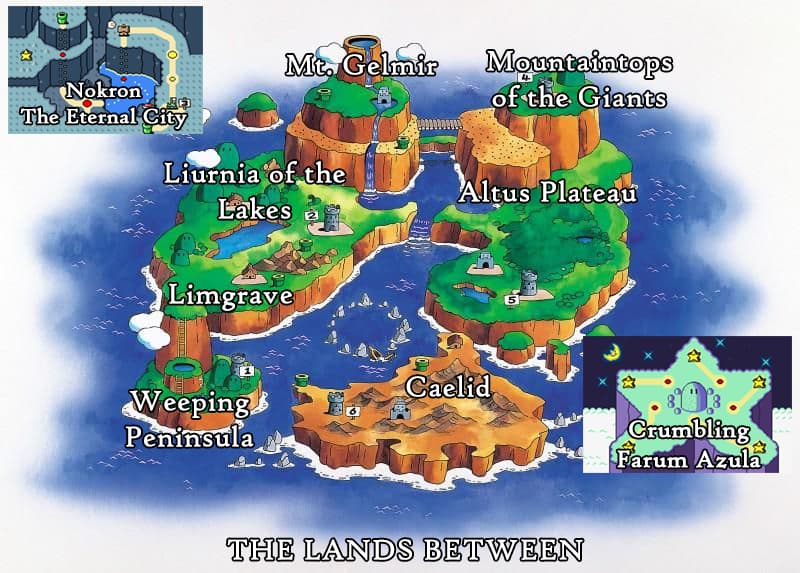
the little ring of rocks around bowser’s ship is even present with the ring of divine towers
1 Like
That jump to get the level 3 smithing stone near the start of the Linuria mine so far has been the thing that’s killed me the most.
5 Likes
this is my religion now
2 Likes
ok i finally read a lot of the thread
i’m levle 116 and i’m 110 hours in and i’ve cleared out every demigod and major boss i’ve come across.
i am always talking about how games should have more missable ‘’‘content,’’’ that i don’t care about seeing everything, i only see what i want to see. turns out i want to see all of this game
i still have a few big bosses to get through
somehow i have not met the dung eater in all this time?? i don’t know how i’ve missed him
i am not very good at this game and i love playing it
shield counters and their almost insanely generous window are my entire strategy
8 Likes
dung eater is rather easy to miss. try exploring the capital again, which itself is an area where there’s a ton of very easy to miss content.
4 Likes
I feel like maybe i shouldnt have attacked the dung eater on sight but he did make some serious threats.
5 Likes