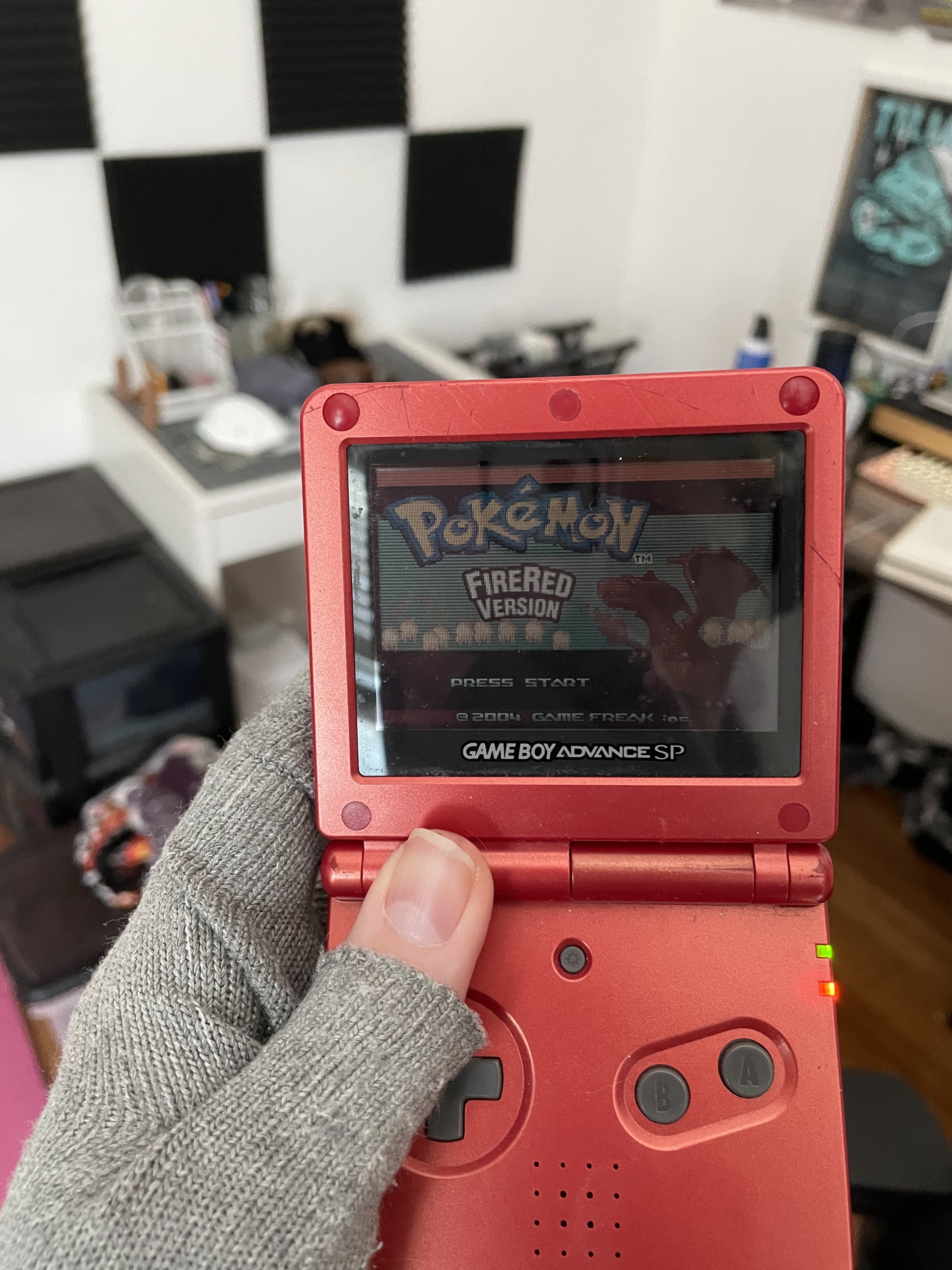
wow what a surprising journey! turns out i got rid of my original model GBA at some point, on the other hand, my SP is the first model (frontlit) and not the later backlit model. on the third hand, it turns out i got rid of my copy of FF 1+2 at some point because i don’t really love FF1 but prefer the NES version anyway. on the other hand of the person adjacent, i have other GBA games, so lets look at a pokersmon
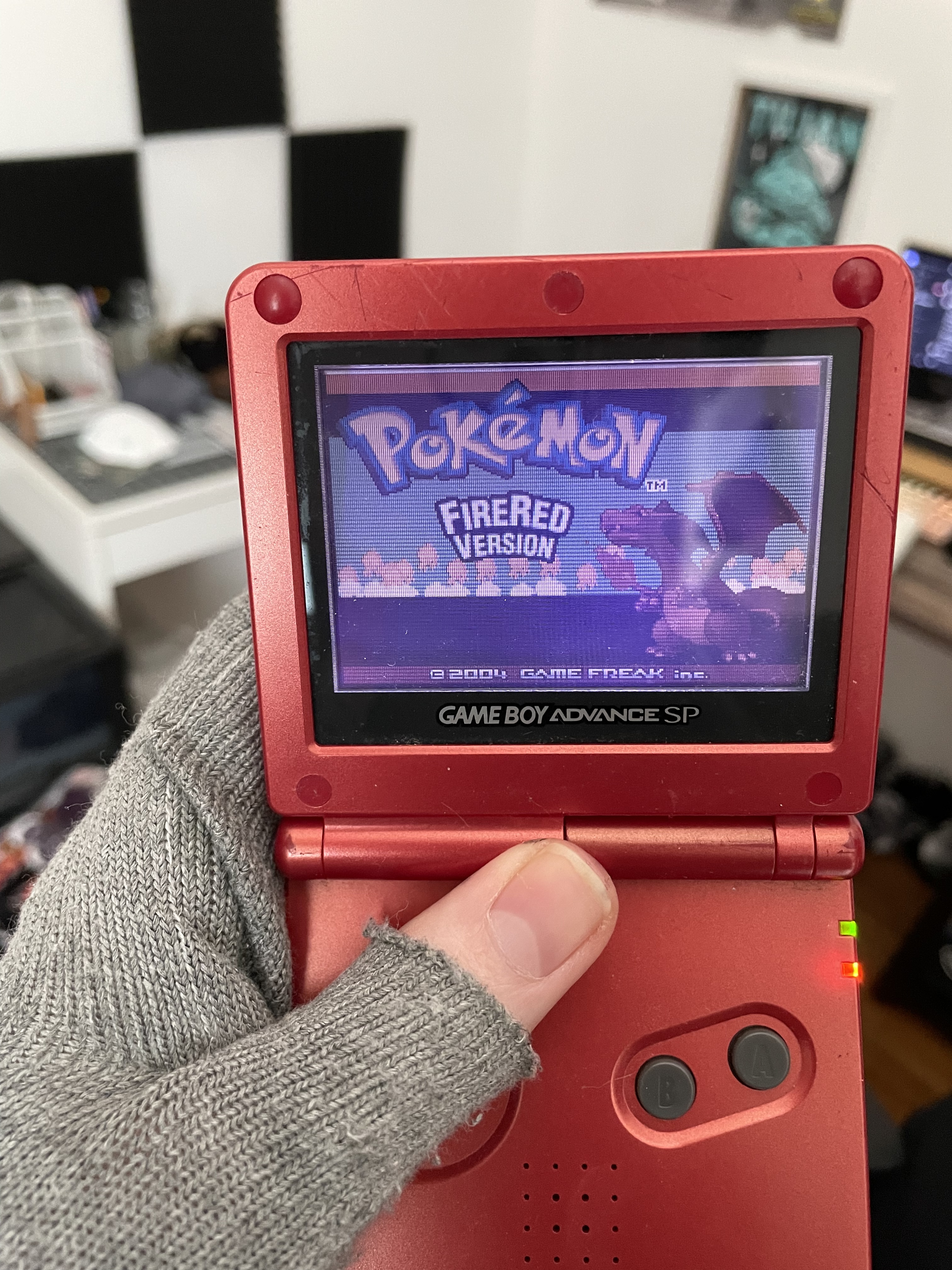
also of course note that 1) my phone camera is absolutely not equipped to capture what this stuff looks like IRL exactly and 2) this frontlight is ugly. my shots are presented with and without the frontlight on, but this frontlights a bit too on the blue end of things imo
god this was really the best photo i was able to take good lord but still i think this gets across the like. moodier look the graphics end up having in real as opposed to the like, raw color of the pixels. here’s a grab off the net of the title screen emulated with no corrective filters:
they’re using really bright ugly ass colors because they get muted by virtue of the way the screen display works. you see this with like all of these handhelds; the GBC or the NGPC is much the same, hell the GBC can technically display a LOT more colors than you can meaningfully distinguish in the end. i love the slightly pastelly washed out look these games actually end up having
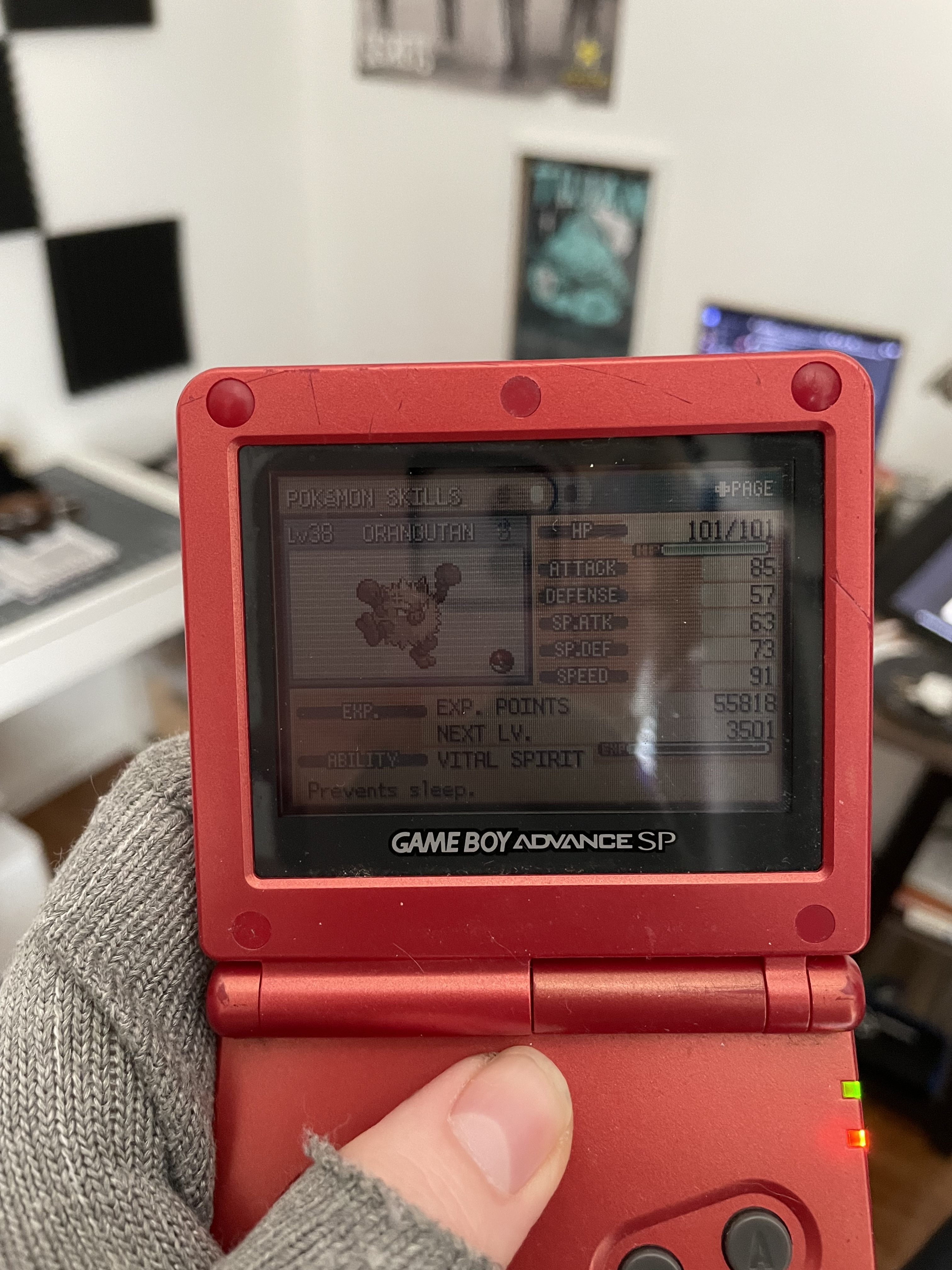
where i think it’s even more noticeable how much being not backlit affects the way they look on real hardware!
i am very glad we live in an era now where there’s really impressively accurate color correction filters for these handhelds, especially because it’s notably more complicated than just a flat RGB correction. it also really pains me that seemingly most people do not bother to use these filters, or various CRT filters for home consoles, etc, because we have the tools now and the tools are fucken good. it especially hurts with the handhelds though cause like. theres not even any setup or tuning; ya just turn it on
Personally, I don’t use them because I vastly prefer an unfiltered view of the games; I know what screen patterns look like, and don’t need them overlapping the game graphics. In the great majority of cases, they hinder rather than increase my appreciation of a game’s graphics; that Pokemon stat screen, for instance, is somewhat unattractive with or without screen patterns on it. And I think most developers of these games back in the day would gladly have presented them cleanly, had that been possible. Unfortunately it wasn’t, and we all just had to put up with them–but thankfully that’s no longer necessary, for the most part. I don’t mind them if it’s an actual photo of a screen, but laying simulated screen patterns over a game just seems ridiculous. Just my own preference. I don’t mind them being an option, as long as I can turn them off and keep them off.
However, I’m the same idiot who happily used “Super Eagle” and like nonsense when those types of filters first became available in emulators, so clearly I can’t be trusted on any of this. ; D
… Heck I got all excited when I first found that “VHSPro” filter in Ares two and a half months ago. ; DD
van Gogh was clearly a fan of dot patterns but I’m not convinced he would have appreciated it if viewers of his patterns could only have seen them filtered through another dot pattern.
the old timers didn’t draw the pixel art on some non phosphor grid screen first and then it got displayed on a crt tv and they were like “what the hell is this now” though, it was drawn on a crt and only ever saw that way. it was not originally made with lcds in mind
I just don’t imagine that the artists were ignoring the fact that their work would be displayed on these screens, even if they did their original work on clearer displays. It seems like a rookie move in any visual medium to ignore or be ignorant of the medium your work will be displayed on, and unless a project was rushed, we’re talking about professionals here.
I don’t think they ignored it entirely. I also don’t think they were wedded to it.
^ I said entirely because in the case of a lot of Famicom/NES games, for instance, including big games by major studios, the artists did ignore that the game would mostly be seen on NTSC televisions, and drew it instead as if the pixels would be perfectly square–so in a lot of those games, circles would have come out as wide ovals for most people, etc.
Judging from the SMB sketches we’ve all seen, I think plot it on graph paper and then step back from it a couple feet was probably closer to how this stuff was composed.
Yeah, I was gonna say, plotting pixel art on graph paper before programming it into a game was the default method for YEARS, it is just as ahistorical to believe they did their work directly on machines
Readability under a wide variety of conditions was the most important factor, though it is obvious that certain devs took advantage of artifacting to pack more detail than is possible if one were to only work with pure pixels
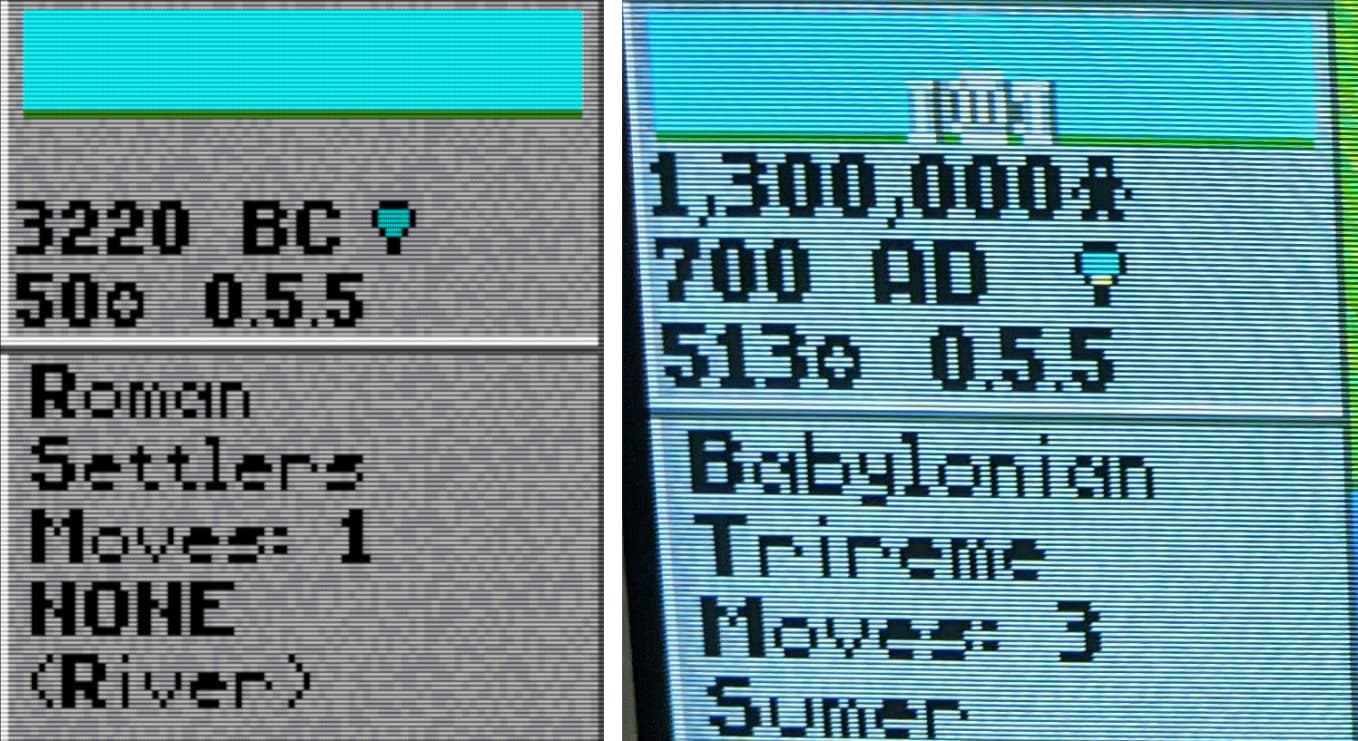
left is shader, right is actual vintage pc monitor, stole this comparison from elsewhere. Actual photo’s colors are off but it certainly still shows just how close they got it without overdoing the effect (this is my issue with most crt shaders, they really overdo the crt effect so you’re not seeing anything more ‘authentic’ than the raw pixel display)
I should not be distracted by the scanlines and shadow masks of a shader and this is something very few crt shaders do by default
ok what WAS the little research meter icon. i was hoping that this would be a mystery solved by viewing it on different displays but i guess not. is it a lightbulb?
The old timers drew on graph paper and wrote the code to display the sprites based on the math. There never was any drawing on screen until the product was a product.
guybrush threepwood wasn’t drawn on graph paper he was drawn in deluxe paint on a computer, that was connected to a crt, not a secret lcd developed from crashed ufo technology. and it seems disingenuous to think console developers were making art on pc screens with no regard for tv’s or that the majority of pc developers were using monitors that were much different from most people.