demon’s’s bosses are definitely more varied and playful which i think makes me love its bosses the most of the series, even if the more open-ended design lets you trivialize some of them (i.e. fire weapons from 2-2 trivializing 5-1 and 5-2’s bosses.)
you can kinda see them refining boss design into a pretty dull formula over the course of the series – i barely remember half of dark 3’s bosses because it’s an endless parade of frustratingly designed aggressive humanoids with unblockable + uninterruptible attacks, but i still look fondly on bosses like adjudicator and old hero because they ask different things of you than “learn pattern, dodge good”
They saw how False King (and later Artorias) got a very positive player response so they formulaized that style of boss and downplayed the puzzle, high-concept or breather bosses that constituted so many of Demon’s.
I mean I loved False King and Artorias too in their original contexts, I guess you always have to be careful what you wish for
Ahahah, breezing through DeS’ first world in NG+ slightly overleveled (or perhaps, having simply leveled intelligently… lv 80) feels like playing Zelda.
Which brings me to a point: several late From SW games work and seem very difficult because, actually, you are very under leveled against the environment. In Sekiro it’s the same.
To extremize things a bit, Owl Dad is so difficult (still havent beaten him) because a hit from him takes away more than half of the protagonist’s health bar. If the protagonist’s sword did the same to him, the fight would be ridiculous.
Yeah, I’d expand that to say that asymmetry between the player and PvE enemies is a near-universal thing in videogames. It’s rarely discussed because it’s almost too obvious to mention, in a way.
It’s more noticeable in Sekiro than in other games because Sekiro otherwise makes a point of establishing a lot of false symmetry between the player and enemies, which each having two lives and a posture bar. But ultimately that’s the same trick I first noticed with Halo’s shields: a complex game-specific mechanic is easier to justify and explain by having the player experience a version of it themselves, even though when it comes down to details it’s not actually the same mechanic.
I think this is a huge part of it. But another huge part is that gamers took so long to “get” DeS that they tried to justify the friction by dunking on low hanging fruit. All the criticisms held against DeS involved stuff that was true and, without context, bad. I’m talking about puzzle bosses, ‘ugly characters’, slow plodding moments, obtuse systems, etc. At a certain point those things are there either to provide respite from the genuinely frightening new territory of the gamespace or flavor what was already there.
Ultimately what separates players from videogame enemies is (functional) immortality. Which is pretty ironic, given the actual physical durability of the two entities.
And expanding on this: if the player has a defense mechanism, the game should expect the player to use it at an 80-90% success rate. Because of this, the penalty for failure should be high enough that it’s noticeable. And frequent, low-intensity failure punishments result in the player not taking the threat of damage seriously – you can see this in its worst form when you look at early PC action games and their tendency to enemies like ‘swarm of bees’.
Similarly, the player is the most aggressive attacker by far. The player wants to be attacking and holding the tempo; normally games shoot for something like 70-90% player control of fight tempo. Souls games are on the low end but the player’s still in control at least two-thirds of the time. So the player is getting way more attacks in, they need an enemy who can resist long enough to get out attack chains.
And don’t forget that you usually want player attacks to succeed. Having attacks blocked by AI fiat in a way that results in the fight state not advancing isn’t very engaging - block and parry games like in 1v1 fighting games are a very different context. Action games exist in a context of a very powerful player fighting many weaker enemies, so the player is managing threat from multiple enemies and need to be making progress in changing the fight circle itself. A block represents wasted time and more danger for the player, not an opponent to be learned.
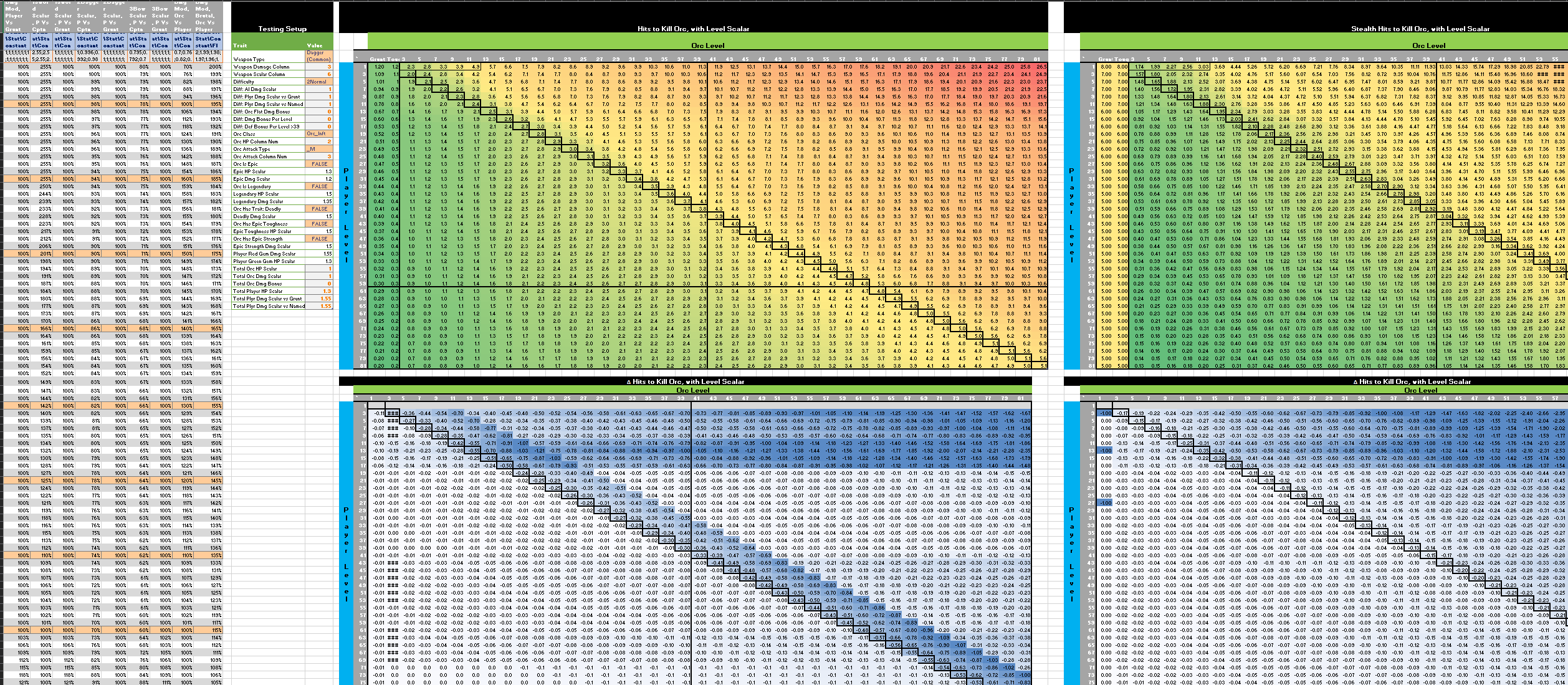
These problems are approached by thinking of combat in terms of hits-to-kill and time-to-kill. How long should it take the player to work through a group? How many mistakes should the player make before a harsher penalty (death & checkpoint restart)?
You should see the contortions stat systems make around player-visible stats and behind-the-curtain stats. It’ll make you puke.
Yeah that reminds me that I never bothered to learn how to fight the tanky Anor Londo outdoor guardians standing at widely spaced intervals with their giant shields. The entire context there makes it so tempting to run past them instead. I imagine most players do the same there (even if I seem to be an outlier in how frequently I go directly to run-past tactics in Souls game in general).
I would say that was a totally deliberate decision by From in the context of Anor Londo, but on the other hand those guardians do have like 5 different attack animations as if you are meant to challenge them 1 on 1 for some reason.
They did a more focused ‘duel enemies’ level in Dark Souls 2 with stuff like Heide’s Tower of Flame. That’s a tough paradigm because to test and teach the player knowledge of the enemy you need repetition beyond a single grunt’s health bar, but it gets real repetitive real quick unless you add complicating factors, which weaken the ‘duel’ theme.
It reminds me that a beautiful thing about Souls enemies is that you approach them over the course of the game with different levels of aggression depending on your current intent – at first, cautiously clearing them all out to safely and incrementally explore the unknown space. Then, running past or killing them in an efficient way on the shortest route back to the boss as you challenge it over and over. Finally, returning on different routes to covenant locations and farming spots, wiping out enemies in one hit with your late-game weapon as you stroll there.
Hmm, right, that’s very similar but I didn’t learn to fight them in Heide’s Tower, either.
I’m realizing for all their multipurposeness, the typical Souls spaces and incentives don’t really extend to that theme, unfortunately. Farming is the main refight incentive in Souls but farming makes you gravitate to enemies that die quickly instead of defending themselves skilfully.
Is Sekiro’s free DLC the first From game to introduce a boss rush mode? I feel that is the most duel-theme-suited context (you could say fighting games have a “boss rush” as their primary single-player mode!) and not by coincidence that is the most duel-themed From game of them all.
Another thought branching off a specific point in your (great) dense post: it strikes me this ratio is an underlying thing that makes game experiences all feel samey. I find myself having a gut reaction of exhaustion and satiation with that pacing dynamic now that you point out it is a Wise And Universal Design Rule Of Thumb.
Trying to think of the rare games I have loved where the environment primarily controls tempo, my mind goes to, actually, Left 4 Dead. The central combat experiences in that series are 1) defensive standoffs against sudden hordes that the game “Director” system controls the timing of, and 2) lurking elite enemies taking the initiative to pick one your team off at quiet times when you have your guard down. Overall, it still meets your rule of thumb of player takes initiative >50% of time because so much of the time is spent on quiet exploration with no nontrivial combat happening, but the meat of the game is defensive. And man, now that I think back on it, I really feel like playing another game with the same tense, high-stakes vibe.
Listen, guys! Now I have played Demon, Dark, Bloodborne and Sekiro. We could say I had my fill…
Is DS2 Scholar of the first sin special too, or should I just wait for Elden ring (or play some king’s field)?
Yes, DkS2 SotS is Good and meaningfully better/more interesting than the rest of the series in its own particular way, just as every From game is. I replayed it last year and it holds up, in fact it exceeded my expectations (based on memories of playing vanilla DkS2 at launch). But, I won’t say you have to play it right away if you need a break from Souls, it will not go away.
One of the major insights I gained as I moved from novice to seasoned professional is the extent to which boring solutions might still be the best solution to the problem they’re trying to solve. If you want different answers, you need to ask different questions.
imo scholar is the better version of DkS2 but DkS2 is very weird in a very disjointed, dreamy way – some people really hate this but some people (me) like it.
i feel like 3 is completely skippable, it feels like the fulfillment of a contractual obligation more than a conclusion to the series
(usual disclaimer on Dks2: do not play a hybrid melee/magic build your first time through, the DLC is full of mobs that are nearly immune to magic and it’s awful unless you have good pure physical damage or magic damage, and it still kinda sucks for mages regardless)