It’s because it’s a bioware game, but a bioware game that everyone likes instead of one that makes them mad, and people need to admit to themselves that bioware games have more in common with jrpgs than some other rpgs!
4 Likes
i didn’t know who this ridiculous person was until this thread and i blame all of you, but i am glad i was able to find some context about him, like reading this bs and then seeing what the game he made is actually like makes all of this a lot funnier
“But, Doc!” you may be protesting, “Japanese developers make 3D games too!” And you’d be right. They do! Which is why I’m not saying that Japanese games were 2D games and Western games were 3D games. I’m saying something… well, just a bit different. Switching gears a moment, let’s talk about JRPGs, and not the whole “they’re not actually RPGs!” thing. Instead, let’s talk about where they’re at their most popular. A common complaint about them has been that they’re not really that well-represented on consoles, to which the common defense is that the great ones are all on mobile devices.
this is the moment i decided that it is not possible to take this person seriously. anyone who acts like they can is surely just like doing an elaborate bit? idk
4 Likes
I also have no context for what’s happening in this discussion and don’t know who “Doc” is etc., so please forgive me if I say anything completely off-topic. This is along the lines of part of the long post I wrote that I still haven’t finished; I thought I would add it to this discussion since it seems more relevant at this point from what I can gather. (Also sorry I’ve been chipping away at this off and on since scratchmonkey’s post a few hours ago which this is more following after, so it doesn’t really take the last few into account which I only just noticed as I was about to post—sorry for that.)
If “RPG” could viably mean anything that solid, there would be little grounds on which to argue about it, I think it’s interesting to note. If someone says something like “negative numbers” for example there’s not too much ambiguity to resolve past that no matter who’s talking, but I think anyone on Earth who has any personal idea of what “RPG” means thinks of it as something at least slightly different from everyone else alive or dead. It’s been applied so widely and so heavily to such a vast array of different games that I honestly think, in full generality, that it can mean almost anything by now.
Certainly the category has something to do with D&D in some sense, and some of the most-widely-considered-to-be-RPGs games definitely owe a lot to Ultima and Wizardry too; that’s a bit more bounded than just “games in general,” but there are plenty of people out there who talk confidently about RPGs while knowing little-to-nothing about D&D, Ultima, or Wizardry, and are thinking mainly of games that only have a vague, five-degrees-removed kind of relation to those sources at best, to the extent that their significance becomes kind of questionable in context. I was like that when I was around 9, and I don’t really feel like I could go back in time and tell myself I was looking at the genre wrong with a straight face.
The “what does ‘roguelike’ mean to you” thread I started a little while back gives a relatively vivid illustration of this situation, I think—just about everyone in that thread would probably agree that roguelikes are a subset of RPGs I think and some people said as much, but no two participants gave the same personal definition for “roguelike,” and some of the definitions are wildly different, to the point of having almost no overlap in some cases. I came away feeling like, if I released a game today and described it as a roguelike in the synopsis, I wouldn’t really be able to predict at all what conclusions any one person reading it would come to—apparently they could think anything from “it’s a slight variation on Rogue” to “could be a sidescrolling action platformer with destructible environments” to “maybe it’s something that would have been in the ‘arcade’ genre in the '90s,” and that’s only going from a few of the posts. If roguelikes are a subset of RPGs, then, how sundry of a category must RPGs be in full, if we try to account for everyone’s ideas together?
Because of this I actually feel like I don’t really know what an RPG is when I see it, to be genuinely honest. Sometimes I do talk about RPGs, or call a specific game an RPG, but usually only if I know who I’m talking to and what they view RPGs as. Otherwise it feels almost impossible to know what the listener(s) will think and I get nervous about even saying the words “RPG”—seriously! I personally feel like I could make an argument that would totally satisfy myself that everything from Arkanoid to Metal Gear to Xevious to Myst to Harvest Moon is an RPG. That would probably rankle a lot of other people and they would want to quibble with me immediately, but if you start trying to nail down the category precisely enough to rule some of the more “pathological” examples there out, you inevitably also rule out some games you would want to include, as I think some other people here have mentioned.
In general I feel like it really helps to figure out what your goals are when you’re setting up definitions like this anyway. Like, in my case, I’m usually trying to figure out what a game I really like is “doing,” as precisely as I can, so that I can learn something from it about game design that can inform my own work. One of the most productive ways I know of to do this is to focus on characteristics of the game that are more akin to something like negative numbers—things that are solid and unambiguous enough that you can make a formal, quantitative model around them. Since computer games are mathematical objects intrinsically, you can always find ways to treat them in this fashion, and you can discover surprising and remarkably useful things about them that way. As I was alluding to earlier, you can also take a set of formal characteristics, find some games that display them, and then see what else those games have in common; that can give you interesting ideas too, especially if you find ways to group together games people don’t normally associate with one another.
I think it can also be productive to view games as literary objects, or in terms of their moment-to-moment affect, etc., and if anything I think those kinds of frames can compliment more formal framings and vice versa—they all tend to illuminate and add depth to each other. There’s no need to stick to only one way of viewing a game after all; you might as well describe it however seems most convenient or productive to you in the moment I think. I remember siobhan using an example of the fruitlessness of asking whether cereal is soup or salad, and in that sense I’d say you might as well try looking at it either and both ways and see what sorts of cereal recipes you come up with.
4 Likes
Perhaps an unstated assumption of my post is that most people use the term “RPG” without really investigating what they mean, or how it might differ from person to person. My point was more of that these games all come out of the same lineage, so what are the differences, perceived and imagined and otherwise, between “JPRG” and “CRPG”? (With “RPG” liberally substituted for CRPG for many people.) And I do think that there’s a greater association of TTRPGs with some Western-developed games, and how that ties into people’s views of simulationism and “choices and consequences” as the dominant paradigm of these games, that puts people into this weird cuturally-based false dichotomy – and I say false here because there are plenty of Western-developed “RPGs” that have aspects that are typically assumed of Japanese-developed “RPGs”, and vice-versa.
(I’m also the worst person to ask about classification because usage defines meaning! People call RPGs what they think are RPGs, and that’s what makes them so, not any actual attribute of the media itself.)
3 Likes
By far the biggest rpg series of last generation was Mass Effect and that is very umambiguously stirring a lot of jrpg back into the crpg mixture… that synthesis is Bioware’s house style, essentially. I haven’t seen crpg nerds anywhere acknowledge this which makes it feel like a forbidden secret but it’s really just obvious if you have wide experience in the genre.
BG3 (and the Divinity games which are very similar) are a bit less jrpg than Bioware, but are still in conversation with that synthesis. It’s certainly more jrpg than Fallout or Morrowind. And yes, that is one of the reasons it’s so massively popular.
5 Likes
https://vxtwitter.com/McFistCR/status/1739407956255342860
His post has escaped containment and been mocked enough that the skeletons are popping out the closet lol
7 Likes
It is really funny to have a take so bad it retroactively gets you cancelled for other unrelated stuff you did a long time ago
11 Likes
I wouldn’t be surprised if he is “a certain person who cannot be named around here” under a different name
1 Like
Ok I guess I started this but I would prefer if we didn’t turn this thread into a place to dunk on doc. Not because he doesn’t deserve it, just that we’re drifting away from even talking about RPGs now.

16 Likes
I guess like, in a way—and maybe this is exactly what you’re saying—if you don’t just define JRPG as “RPGs from Japan,” and look at it more as a sort of distinctive aesthetic tradition or something like that, it’s really hard for me to see its edges even vaguely to some extent. Something I was thinking about as I read your post is how like, in the '80s, most Japanese RPGs were for home computers, and as you say they’re strongly influenced by the same games that American and other developers were riffing on (Wizardry and Ultima). I actually feel like in that era, at least from what I’ve seen, it’s much harder to find overarching stylistic differences between RPGs developed in Japan and elsewhere, at least in ways that go beyond just like the distinctive styles of individual developers or whatever—there was a lot of cross-pollination and people playing each other’s games and things across regions anyway as far as I know, especially since it was kind of a small world even internationally, particularly in terms of people in Japan playing games from the U.S. (even if they had to play in English and so on). There are somewhat different conventions among the Japanese CRPGs and such from then but at least the games I’m familiar with have a relatively similar look/feel/UI/etc. to something like A Bard’s Tale or Might and Magic, in another sense Ultima III, etc., and I think would have gone over fine in the U.S., although I don’t know that any of them got an official release here; they’re largely in Western-style fantasy settings and things like that even though.
I kind of suspect that a lot of what people think of as “JRPG” comes from the fact that the Japanese commercial game industry moved almost entirely to consoles in the late '80s/early '90s, whereas in the U.S. at least the RPG developers mostly stayed on home PCs during that time. Of course consoles of that era posed serious challenges for RPG-type games, lacking a keyboard or mouse and having very limited storage before CDs came along and so on, which would kind of just force them to become something else regardless of where in the world they might be. On that basis I get the impression that a lot of developers in Japan were very pleased to have Dragon Quest as an example of a way to do an Ultima+Wizardry-esque game that could actually play well on the Famicom. It makes sense to me that that became its own sort of historical tradition with time, but I imagine that if most RPG developers here in the U.S. switched to making NES games they too would have been very influenced by Dragon Quest for the same reason, and would’ve ended up making similar games.
Because of all this I feel rather like it would’ve made more sense back in the '90s for people to just have differentiated between console RPGs and home PC RPGs instead, since I think so many of the differences just come from that—maybe the console RPGs happen to have come largely from Japan and the home PC RPGs largely from the U.S. then, but it seems kind of like a coincidence to me that things went that way, since it wasn’t like that at all in the '80s and it’s not so much like that now either. Of course, it’s maybe also kind of a coincidence that the market for games blew up hugely in the '90s, so a lot more people were paying attention to what was going on then compared to before, maybe making it seem kind of like the situation at that time was how things had always been. Last but not least, Square singlehandedly did a lot to define what “JRPG” means now during that time I think, and they’re a really weird developer that had a very specific thing going on then which goes way beyond them just being Japanese I would say, but I also kind of feel like a lot of people here in the U.S. might not have been very sensitive to that, just because a lot of people didn’t know much about Japan at all from what I remember (I certainly didn’t back then).
Just as an addendum, maybe you already know but I just thought it was worth noting, Japan does have its own tabletop gaming scene, for what that’s worth; I’m not a huge expert but I know about things like Sword World RPG/Record of Lodoss War and Ryuutama (I’ve actually played that one a tiny bit) and so on, and it sounds like some translated American games have a following as well. I don’t know that tabletop gaming is as popular proportionally there as it is here these days, but I will say too, as recently as 2010 at the very least I don’t recall tabletop gaming being very popular here either—as someone who was really into it in the 2000s I remember it being intensely nerdy  and little-known among the general public, although probably more popular with game developers on average I guess. It does have a longer history here of course as far as I know—I think it wasn’t until the late '80s that tabletop gaming took off in Japan—and of course these days it seems to have had a huge surge in popularity here for some reason although also only D&D for some reason which I don’t really understand. In any case though, I actually feel like some '80s-era Japanese CRPGs have a strong tabletop-esque atmosphere also, with like Wizardry-style dungeon crawls and text-based towns with pretty writing sometimes and things like that; even if the developers weren’t familiar with those sorts of tabletop games firsthand I think they got a lot of it through osmosis via Wizardry and stuff, and with the light use of parsers and things they kind of have even more of a tabletop vibe than Wizardry does you could maybe say. (I’m thinking of things like Koei’s Dungeon, Mugen no Shinzou by XTALSOFT, Parallel World from Enix which actually has text-based building interiors instead of dungeon mazes and a more complex parser and even NPCs that change location and things, etc.) It’s honestly rather sad to me that games in that kind of style sort of stopped being made there once consoles really took off, at least as far as I can tell…they may be a little clunky by modern standards but I feel like they have a special atmosphere.
EDIT: God sorry for the rambling post  I’m really sleepy…I can’t say anything much about my conclusions here for absolute sure of course too, I acknowledge this is all just speculation and subjective opinion kind of.
4 Likes
i think we should retire JRPG/use it broadly to refer to anything we could consider an RPG that is from japan, and for the much narrower range of games in the tradition of dragon quest/final fantasy we adopt the label “dragonfantasy”, a la metrovania
11 Likes
I remember having a heated argument with a friend in high school who insisted that Duke Nukem 3D was an RPG. I think he was either confused into thinking ‘role playing’ referred to the first person perspective, or just generally games where you ‘play as a character’ ie any game where you’re not just controlling a cursor or something.
Back then, my only exposure to the genre was through 16bit JRPGs and Daggerfall, and I didn’t have much familiarity with the table top variety, so I figured the meaning of ‘role playing game’ was simply a game where you are ‘playing a role’ in a story, like a theatre show. So basically any game where you need to advance the story by talking to people and triggering events. This kinda stopped making sense in the later years when practically every game started to become cutscene heavy though.
6 Likes
i’ve had a long think abt what makes a jrpg work for me, and i’ve settled on a particular grade of long-term hangoutability that condenses out of the following ingredients:
-
party:
i like having friends! or at the very least a friend. this can be abstracted in obvious ways like pokemon, or in less obvious ways like having a mech or something. but if you take that route you have to work harder to make it land and the effect is different.
an addendum to this is that i don’t particularly care for playing “as myself”, and i’d much rather play as one or more named characters with their own personalities. this feels very jrpg-y to me, but it’s something i appreciate in all story-driven games. -
towns:
similar to having a party, but like, zoomed out another level. i like being part of a world that was living before me and goes on without me. towns are also prime vectors for graphics and setpieces and cute npcs, which is very important.
scale is important here too. i like that we’ve collectively settled on towns rather than cities, because they’re easier to navigate, and there’s a diorama quality which i personally find endearing. -
appreciable narrative scale:
i don’t mind a story about saving the world, but i’d prefer a story about saving a person, or a town, something at a scale that i can comprehend. if the story has to be about saving the world, then i want a narrative that has space for grand plot arcs and small, low-stakes stuff; it makes both land better. this is part of why i enjoyed yokai watch 2 so much; even though you’re saving the world, you’re always doing dinky side-missions and being a kid the whole time. -
weirdo combat abstraction:
i have such a hard time expressing myself succinctly on this topic, so please forgive me if i go on for a bit. i actually really like combat as a core part of jrpgs. i feel that it’s a necessary ingredient (for me), but it’s also where a lot of games completely fall down (looking at you, vagrant story).
i don’t wanna do hardcore action game shit in my peg but i also don’t wanna do the stereotypical taking turns throwing numbers at each other until one of us falls over (a stereotype which i can’t even pinpoint the origin of. is it faifan? is it dq? is it racism?). the important quality, as always, is how much i can hang out with the combat. i think this is why i gravitate towards “easy but active” combat systems, a la ffxv, resonance of fate, pan drag sag, and so on (i’d probably have a chill time with the mario rpgs – paper and otherwise – for this same reason). i’m pretty sad that this format has fallen out of style, and i eagerly await the inevitable shift away from everything being a drab serious realtime action game so that designers can once again turn their skills toward the holy task of making gloriously stratified perfect number machines with exquisite graphics.
oh and the menus need to be sick as. i love hangin out in a menu. i thought bravely default was some trite bunk but i still think about how you can navigate its menus entirely with one side of the controller and why has no one else done this i don’t understand it’s so gourmet.
i recoil a little at phrases like “junk food games” or “comfort games” or similar, but i understand where they come from: that certain level of friction that allows a game to be engaged with in the long term. i don’t want a uniform textureless experience, but if a game is going to expect me to hang out with it for more than 10 hours then i think it needs to be designed around that elusive perfect friction… which is why most rpgs shouldn’t be any more than 10 hours long!
16 Likes
Yes… Hahaha… YES!
8 Likes
This isn’t definitive, even for me, but playing Dragon Quest makes me think a JRPG is essentially an exhibition of beautiful pixel art where enemy encounters serve as frames on the gallery wall. Visiting a new location with new enemies is like entering a new room of the gallery, with all the relational and sequential logic that implies. Seeing an artwork in a gallery has a totally different effect to browsing an online archive, and the same applies to encountering pixel art in a game vs viewing it in a Fandom wiki bestiary.
I’m always compelled by how the logic of the enemy design in JRPGs exists in parallel to and largely unacknowledged by the explicit logic of the story. Even if it arose simply as a consequence of the division of labour between the art department and the scenario writers. Don’t want to fall into the trap of drawing boundaries, but if an RPG tries too hard to naturalise this relationship and produces dialogue like “I’ve fought mudcrabs more fearsome than you” then, uh, maybe that game craves a different interpretive framework.
8 Likes
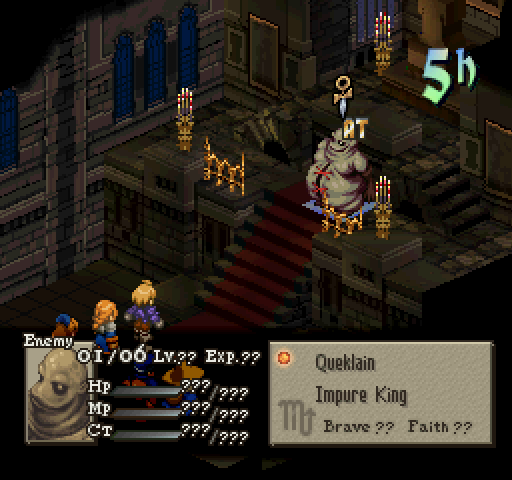
really like this interpretation of looking at FFT with a theater lens. something interesting to add to this is an effect i learned back doing plays as a kid - where two actors who are in a conversation in a scene, rather than facing each other directly, sort of angle like a V shape so the audience can better see the faces and body language. this was explained to me as called ‘copping out’ - but searching now i can’t find whether that is a globally adopted term
thinking this has a really direct analog in a tactics game, where not only are all the characters posing isometric - which forces them to do this ‘copping out’ - but each map has varying levels of elevation, which in ‘blocking’ terms usually has some connection to portraying differences in status between characters in a scene.
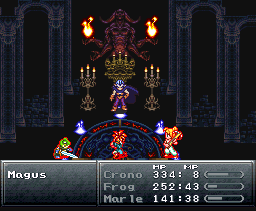
comparing that idea of ‘status’ to more standard 2d rpgs, usually for important scenes you have the villain positioned at the top of the screen so you can see their expressions and movements, and your party gathers at the bottom, seeing their backs and maybe some action poses. its a lot harder to effectively place together a relationship between two characters in side view. it just sort of comes with the package.
boss fights
6 Likes
Far as I know the term is “cheating out”
1 Like
ack you are completely right ahaha. no wonder the search results were inconclusive lol