I believe that the comprehensive rise of casual gamers is significant. Even during the arcade age, there were three types of drug gaming profit models: horse racing, mahjong, and slot machines. Back then their ability to attract non-gamers to spend on these products was not strong, and their market deployment capacity was insufficient. It wasn’t until the emergence of smartphones that the ability to distribute this content increased. If the sample size is large enough, the model that eliminates diversity and interest can function effectively, ultimately leading to a money cycle.
As Broco said, coding-puzzle interviews is a good example: it’s closely related to the increasing market then number of developers, the greater demand drives graduates from different fields to quickly enter the Internet industry through bootcamps. Finally, the originally worst models (which will let the company to lose truly creative talents) begin to become the most effective (bring in a large number of salary-driven employees can good at repetitive tasks, when the market size is raising at the same time).
I found the Soul Calibur bit in this paper interesting.
The threat of Western imperialism is shown vividly in the opening cinematics, as we see samurai swordsman Mitsurugi Heishirō facing off against Western soldiers… In the narrative, Mitsurugi hails from Bizen, home of swordmaking and later allied with the Satsuma and Chōshū domains in southern Japan, both of which used European rifles, ships, and artillery for their troops. The Tokugawa years saw the emergence of the shishi, or “men of high purpose,” fighting for the emperor and older Japanese values in the face of encroaching Western powers. As SoulCalibur is set earlier, Mitsurugi may be understood as a symbolic precursor to the shishi, living the creed sonno- jōi, “Revere the Emperor and Expel the Barbarians.”
This kind of Japanese nationalism is not prominent in the narrative or game dynamics but underlies visual representations of characters as well as the privileging of samurai archetype Mitsurugi in the character select screen and user interface. By placing Mitsurugi’s act of defiance so prominently in the opening cinematics, the image of Japan- as- colonized is maintained. On this point, Mitsurugi Heishirō also illuminates the portability of Japanese ideology overseas.
…
In contrast [to kof, tekken, etc.], Mitsurugi’s entire visual makeup emphasized his samurai status, an unacceptable and abhorrent figure for the mainland Asian market, recalling banzai charges of Japanese troops in the recent past. For these reasons, Mitsurugi’s character in SoulCalibur II was changed to “Arthur” for export to Asia; he retained his physical stature and sword-wielding prowess but acquired blond hair and beard plus an eyepatch, providing some concealment. The samurai colonizer of Asia was thus reconfigured into European knight (and, by implication, subduer of non- European peoples through history). It is notable that Arthur’s clothing retained distinctly Japanese elements such as tabi socks and straw sandals, and his sword is recognizably a katana, bound with ito braiding with a tsuba guard on the hilt.
…
This equation of Japan with the West echoes theoretical positionings of Japan as part of the Global North, but the fact that this image was made for export to Japan’s previous colonies for the express purpose of erasing Japan’s colonial presence in the region and making money from the result points to a more complicated relationship.
I’m more shocked that she chose Soul Calibur, this series maybe has the the most complexity character version in different console of fighting game history. Even a Japanese scholar want to discussing this topic would need to play all the version, known Korean, familiar with the rising of South Korean gaming community at 2000s, and always remember the infamous quote by Hiroaki Yotoriyama at South Korea (All the move based on Mitsurugi), yet she write it with such certainty to hurry embed it within so simplicial anti-colonial framework lul.
If you wanna knew what South Korean players really cared about.
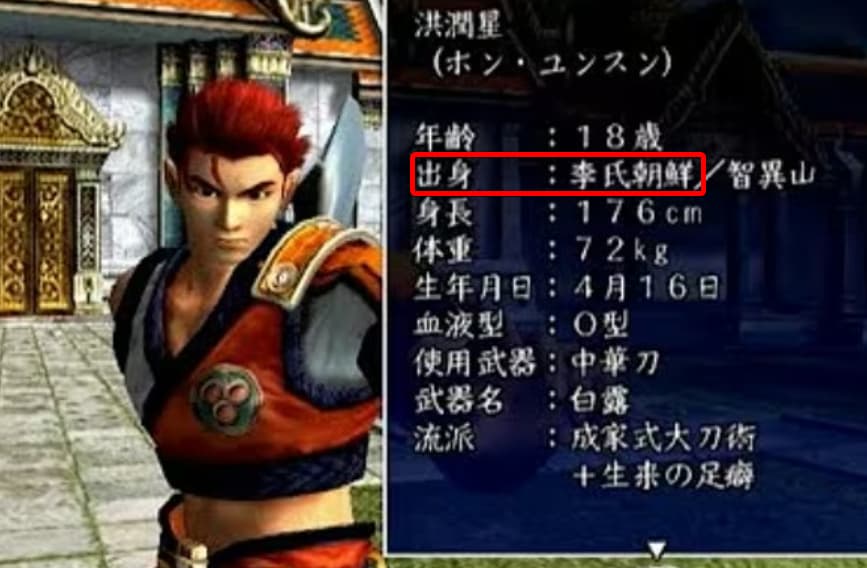
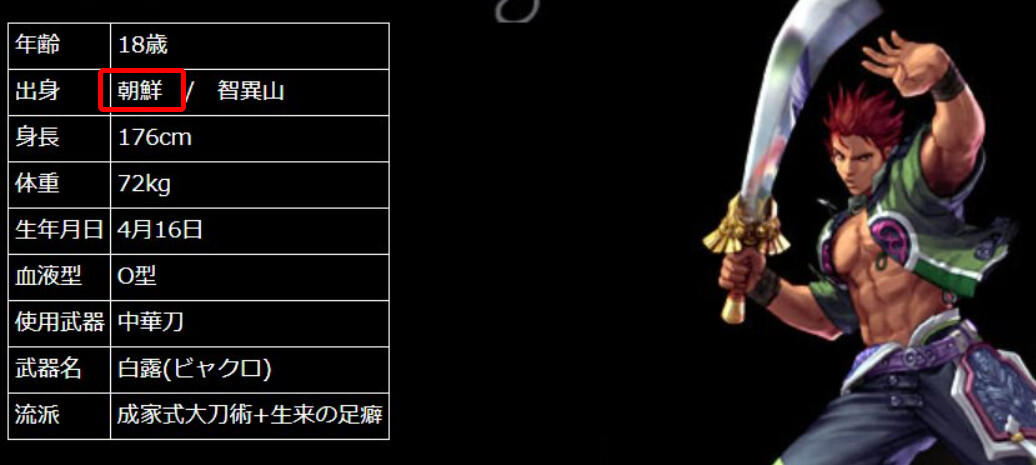
The setting uses the term Joseon Dynasty 李氏朝鮮, this is sometimes misconstrued as a derogatory term for Korean in Japan, but this is not the case. Up until the Soul Calibur 2 arcade game, the character’s nationality was listed as 李氏朝鮮. Following a petition in South Korea, the nationality was changed to 朝鮮 or 韓国 for the Soul Calibur 2 home console version.
for me a developer race swapping a main character corresponding to areas with/without recent memory of them as a colonial ruler is a unique way game memories r shaped. not particularly attached to the paper but do think the anecdote is interesting. doki doki panic. not sure I understand everything ur saying re: “infamous quote by Hiroaki Yotoriyama” , sounds interesting would love 2 read more tho…
He once mentioned in a South Korean event that the development in Soul Calibur series are always start with Heishiro Mitsurugi and other characters were modified from Mitsurugi’s moves. And later it extended to Soul Calibur is Heishiro Mitsurugi in the community.
Yes, in fact the actual situation is much more complex. When the ban policy was still in place, Japanese companies could disregard the international situation and publish games like Samurai Shodown, smuggling them into South Korea through Korean mafia Kim Kaphwan (Yes, Kim Kaphwan), which widespread popularity in South Korea. However, in the late period when the ban had become meaningless, both the South Korean and Japanese right wings attempted to use the Dokdo Island conflict during 1996 to 1999 incite the public against these games, resulting in numerous modifications instead. Rather than saying it comes from Japanese developer or colonialism, it’s more like to the sensitivity to made a guide line of South Korean publisher to rising nationalism in the South Korea.
Oh yeah, it was wild renting anime from Korean video rental places in the early 90s and seeing giant ugly bright neon pink censorship boxes over any Japanese characters or signs in city backgrounds. I also remember they edited series down so like Sailor Moon was missing a bunch of episodes (but I guess so did the US version), and Eva was also shorter.
I keep thinking about how Ranma especially got censored (or localized?) where Akane and her sisters were renamed “One, Two, Three” even though her door still had a name plate that said “AKANE” on it, though it was in English so it didn’t get hit by the giant neon censorship block.