And Milkshake Duck’s mention on the games wikipedia!
2 Likes
“hoi 0 results”
5 Likes
Yeah pretty sure this is the same game i was thinking about, just that it’s maybe pivoted away from being overtly anti woke to being some AI slop thing that’s maybe subtly anti woke
Atari has owned MobyGames since 2022.
(MobyGames only mentions this once–in a long list of other credits on their About page.
Here’s Atari’s corporate podcast interviewing one of the site’s co-founders, and the current admin:)
1 Like
I’m always thinking they should probably publish some catalog index books on kickstarter, I would love to buy one named as DOS GAMES ON 90s catalog by them.
3 Likes
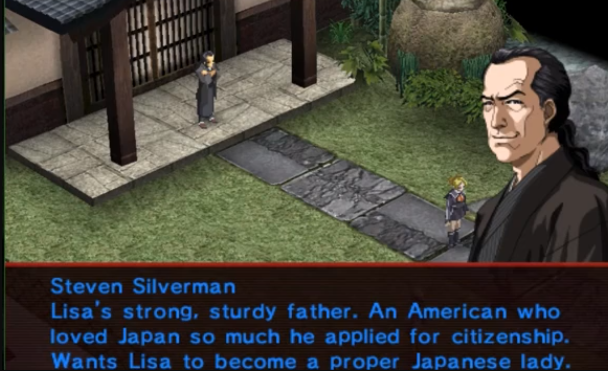
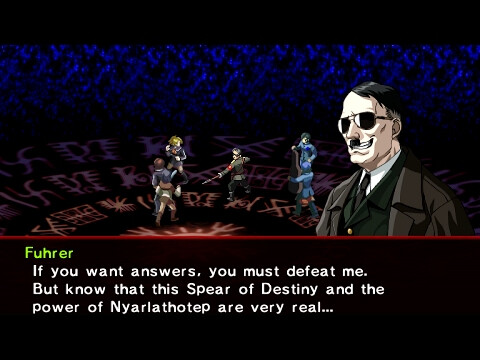
Ayako Fujitani reference?
2 Likes
I wish! at that time she was most famous for Gamera and Lisa doesn’t really resemble her
1 Like

Poppy Playtime is not titled ‘Poppy’s Playtime’ as many refer to it as. Recent Mandela effect thing I think about a lot.
9 Likes
wow is that summary an LLM thing? god…
1 Like
No one talks enough about how The Legend of Zelda Majora’s Mask (easily my favorite Legendo Zeldo game + one of my favorite games period.) was developed under severe crunch that gets played off in a funny little story where Beloved Smiling Mario Grandpa Shigeru Miyamoto tells Eiji Aonuma “haha no but really complete this game in 1 year or you’re fucked and the whole project is sunk” and then it’s a game that mostly recycles elements from OoT to tell a story about racing against a constant ticking deadline to save a bunch of people youve grown to love while a scary smiling man covered in masks judges you harshly for every choice you make that isn’t “get me back my fucking mask.”
just think it’s a game that ought to be brought up more in conversations about 1. crunch in game development 2. the ways that limits & restrictions can define works of art 3. Shigeru Miyamoto being probably kind of scary and also probably kind of a dick
Also it holds up pretty well but i replayed it with the static recompilation which allows for mods so like i had full camera control and built in shortcuts for all the TF masks + instruments and shit
22 Likes
My impression is that nintendo is kind of a nightmare to work for in general and anyone who became prominent there did so through terrible work/life balance, I think this bit about the production of Mario 64 DS (from now silent hill producer motoi okamoto) often enough 2 include in here
Q&A: Design lessons learned from a decade at Nintendo's EAD.
My experience during this game’s development made me want to create a Mario platformer played only with a stylus. But I never got the chance.
In those days, Miyamoto would come to us at 11 PM, after he finished all of his board-member work, and say, “It’s Mario time.” At that point, we’d start a planning meeting that would run until 2 AM. At that point, Miyamoto would go home, leaving us with the words, “You should return home soon, for your health.” Over the next two or three hours, we’d write the game design documents and summarize the instructions for our artists and programmers.
It was the craziest crunch time that I’ve ever experienced in my development career. But if the God of Games was working so much, could we give up? Miyamoto had incredible stamina.
16 Likes
That’s just Japanese companies in general, especially before people started going on the internet and learning that in other countries they have labor standards.
3 Likes
He alludes a bit to that,
My first impression after entering Nintendo was that the company was, surprisingly, a big traditional Japanese company. There were many elderly employees who had been working there before they had ever launched their first video game console. All employees had to submit a daily report on paper every day, in 1999, when each of us had a PC on our desk!
Even the software development staff wore a company uniform like the ones the workers wore in the factory. Of course, I had known in advance that the company was old-fashioned, but when I actually experienced it, it was older-fashioned than I had imagined. But within that old-fashioned organization, the development studios pursued their own unique rationality, such as the development of JSYSTEM.
A few years after I joined, our president Hiroshi Yamauchi stepped down in favor of the young president Satoru Iwata. He would dramatically reform the old Nintendo, analyzing the problems of the company one by one.
NIntendo Digression
Satoru Okada’s take on that period was something I read recently and interesting in contrast to that interview:
From a 2022 retrospective
Nothing is ever decided at meetings, I believe. In terms of leadership, President Yamauchi would often give his opinion about things. But for the final version of the product, he would leave it up to us. He was fine so long as we created something that met our own expectations.
President Iwata, on the other hand, had a more cooperative style. When we couldn’t decide something even after many meetings, we would ask Iwata to make the call for us. But then he would say “OK, let’s have a meeting about it”…! For me personally, he over-valued cooperation, and the result was that we often went around and around in circles.
Personally, I have a tendency to want to make decisions myself and do things on my own. President Iwata never got mad at me exactly, but he did give me warnings: “From now on, I want you to follow the proper procedures.” I was like… when I did that, things turned out badly. (laughs)
President Iwata knew what things were like for the developers on-the-ground, you see. And he also had to be concerned about what sales and management thought. But the developers should not be guided by them, I believe.
When I quit Nintendo, Iwata came to me. “I’ve seen many people come and go over the years here, and most are lucky to have had just 1 or 2 hits in their career. Please… tell me your secret, how did you keep putting out hits?” But all I could say in reply was, “I don’t know.” (laughs) When I think back now, I realize that while I was often ordered to do this-or-that by management, those tasks that I thought were a waste of time I just didn’t do. I would avoid it by pretending to do it. (laughs). My policy was to only do things I that I could find satisfaction in.
Anyway, things are more restricted for Nintendo employees today. If they have some idea for a game they want to talk about, it’s like “if I bring it up, it’ll conflict with what the other departments are doing, so why bother.” Or they’re concerned about NDAs. On the other hand, I’ve had people run their game ideas by me, and I’ve said well, why not make it on your own and see how it goes? And they tell me if they do that, people will get angry with them. I mean, I understand that’s Nintendo’s official position and all, but I feel like the younger employees are too bound by compliance considerations.
And then from a 2014 interview right before he retired:
I think employees are too restricted by compliance, internal regulations, and so forth. If you want to begin something new you have to get permission from so many people above you. When ideas exist only as ideas in your mind, it can be difficult to convey them to others. That’s why developing prototypes is so important, but in the way things are currently done, there’s too much adherence to planning schedules.
I also think that rather than making everyone work long hours and wringing the life out of your employees, results should be emphasized, and those who achieve should be rewarded with a higher salary.
…you can’t only work on projects that you personally think are great. As an employee you have to take advice and guidance from those above you, and you can’t always completely ignore it. At a game company, when you’re ordered to do something you shouldn’t just say “It can’t be done.”But the problem is that if you just let time pass and do nothing about a bad order from above, in time it will ruin the whole project. It’s fine if you have an alternative idea to begin with, but if not, people end up wasting their time pretending to work. (laughs) That’s an unreasonable situation no matter how you look at it, and soon there will be an angry backlash from all sides. Yet if you state your opinion too strongly to those above you, it could hurt your chances to rise in the company to an executive officer. I never made it to that level myself. (laughs)
I appreciate that pre-retirement he kept throwin out “maybe we should consider there might be a very good reason some employees ignore their boss and slack off?” and then after was like " yea my secret was i ignored my boss and slacked off. they gotta bring that back". wisdom.
23 Likes

9 Likes
I watched linklater’s new film Nouvelle Vague a few weeks ago and thought about the critique that it’s not worth making a reconstruction of a film that’s already a real time construction of itself which now has me wondering like the above which games are the best representations of their own making.
4 Likes
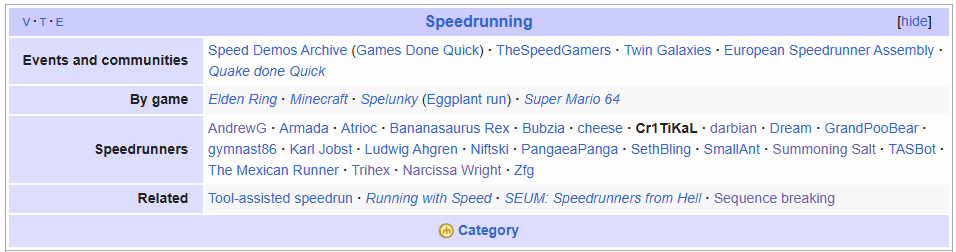
lots of weirdness with these lists, not the least of which is the fact that moistcritikal’s article makes zero mentions of speedrunning or being a speedrunner
very weird disjoint between things that are considered important within a community and things which meet wikipedia’s notability guidelines
4 Likes