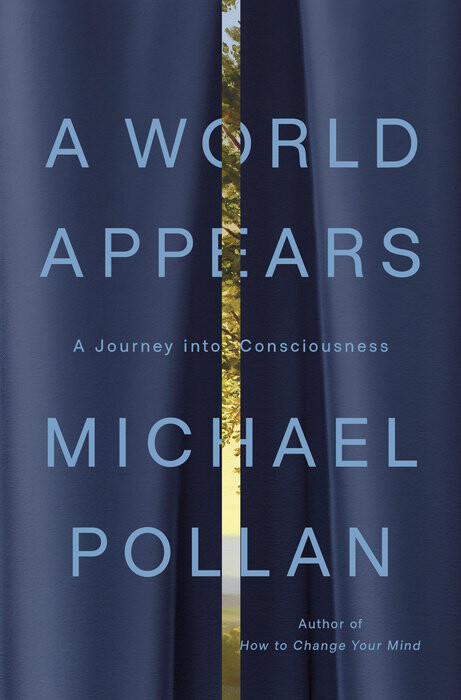
I’d been looking forward to reading A World Appears by Michael Pollan for quite some time, having found his previous book How to Change Your Mind informative and entertaining.
This one is about consciousness, and he starts it with a quote from The International Dictionary of Psychology: “[Consciousness is a] fascinating but elusive phenomenon: it is impossible to specify what it is, what it does, or why it evolved. Nothing worth reading has ever been written on it.”
Pollan’s writing style is so conversational and almost autobiographical that it’s a little surprising how much he packs in. I kept notes of page numbers to revisit, and going through those afterward reminded me how many ideas I want to remember or explore further.
That any cell in the body can do everything a neuron can do
That if you cut off a planarian’s head, it grows a new one and retains its memories
The idea that we don’t retain memories before a certain age because we don’t yet exist as distinct selves
The idea that emotions are not reactions to events in the world but the brain’s best guess on how it should react to changes in the body (such as heart rate).
Just finished Earthlings by Sayaka Murata. I think I liked it, but also not sure how to talk about it. I was kinda mixed on the first half, but will say I enjoyed whatever the final chapter was going for.
Currently diving head first into Children of Dune ready to finally get into the Dune sequels.
Finished reading A Fire Upon the Deep by Vernor Vinge. Holy moly, I loved this, what an excellent scifi book. Here’s my review.
This is probably now my favorite science fiction novel! I was enthralled all the way through.
Though I thought the story was overall good, the best parts are definitely the alien-ass aliens, and the setting. A lot of the best parts of the story are simply showing the implications of the setting and the species in it. Our characters are all very rational and do their best to work a problem that is well outside of their league, which makes for some great fun.
The aliens of the novel are weird and utterly inhuman, which colors their society and social structures and technology in a way very few stories tend to even try. There are, for example, the psychic dog-rat Tines, which share “processing power” in packs to form one mind that is the sum of all the dogs in the pack, so if they take on a new member their personality changes by that addition. It’s really really cool to see characters change into literally new people throughout the course of the book as their pack changes, including their motivations, their fears, their inclinations. For as much time as the book spends with the Tines, I wanted more, and maybe as a result of having so many concepts in one book, none of them feel all-the-way explored. I would often find myself thinking about the implications of this or that, and those things are not usually explored, instead following a more realistic (and less dramatic) result.
The setting is an extremely interesting division of the galaxy into four “zones of thought” that presumably prevent young races from being destroyed by vast intelligences in the Beyond, like humanity might destroy a species of bug or plant. This means people can hide out in the Slow Zone where FTL or sentient AIs aren’t possible, or push up into the outer rim, where they are very small fish in a big pond. It’s such a great element of the story that you never understand the motivations of the Transcend species that have some reason to dive down to our level. I love that these beings are merely things to be survived, like animals might survive a highway.
If I had any gripes, it’s that the main characters don’t really make any decisions that aren’t simply the most rational thing to do in a given situation, which is realistic and reasonable but can be a little disappointing when you want to see x or y concept explored more. Ah well, there’s two other books, I’ll definitely be reading them.
Burned through Kitchen Confidential by Anthony Bourdain very quickly, it’s not a super long book, but it’s also very pleasant to listen to, and very interesting, so I devoured it in a few days. Here’s my review.
There’s a great air of authenticity to this book that I appreciated. Unlike Heat, I didn’t have to keep this distance of having to separate what was his real feelings vs what he wanted to be heard saying. I’m sure there is plenty of that going on here, but the feel of it is - as he states in the final chapter - a book he pounded out on his one-day-off-a-week, which he did not have a lot of time for, and thus, had little time to analyze or craft. I liked that.
The feeling of the book is of a guy with 25 years of experience in an incredibly high-energy business, throwing it all on the page, sorting it into anecdotes and chapter subjects, and then moving forward to the next thing. I liked what he chose to spend his time on. Sometimes he would be looking backwards, wistfully, on his messy first few jobs, and I liked how little romance there was there: It was sometimes bad, it was something great, it was often the two of them at the same time. That carried forward into the present, in how he described his best jobs, his most tragic ones, his more mind-numbing and pointless jobs. They all meant something, and they were all things he had to choose to stay with or leave, with this notion that he had finite life to live and wasn’t about to live it on a job that didn’t excite him.
Tons of great, useful information here. Exactly what you might hope in picking up a book like this. I was impressed, and am going to check out what else he ended up writing.
Also, I really liked the introduction by Irvine Welsh at the start, a segment written after Bourdain’s suicide. I’m a fan of his and he clearly had great respect for Bourdain, and it’s just nice hearing an author you love talking about someone he respected too.
Taking a trip to Italy next month and wondering what would be fun to read in prep, and while there. I might look at some of the books of travel writing that NYRB publishes. I also have a copy of John Williams’ Augustus, which may or may not be a good pairing? idk… any suggestions?
Wrapped up Three Parts Dead by Max Gladstone. I wasn’t nuts about it as a story but I found a ton to like about the world it was set in, and I’m overall glad I read it. Here’s my review.
A lot of very interesting world-building here, set amid a moment where technology and magical sciences have progressed to the point where the gods humans once prostrated before are now seen as different forms of familiar life, ones that can be understood and even surpassed in some ways. It’s cool seeing the artform of lawyering pacts replacing blind faith, and the unease with which divine beings consider the encroaching and clumsy human experiments with powers they don’t fully understand. Also fun seeing a good variety of life, with gargoyles and vampires and litches, things like that, all co-existing in various ways. I wouldn’t necessarily say the story benefits from having, say, vampires, but it’s fun enough to have them involved.
I was pretty underwhelmed by the story itself, which is, at the end of the day, still a murder mystery, where one evil individual or group is responsible and everything is to that plan. A good amount of the mystery is just telling the reader new things the Craft can do, such as changing bodies or mind-controlling others, and you don’t really get all the pieces to how their magic works, you’re just told them at various points of the story. It’s kind of like, how do you make a murder interesting if it’s in a world where anything might be possible? I think I would’ve liked to have more explained about the Craft before so much of the story revolved around knowledge of it.
The main character’s pretty quippy and doesn’t really undergo any kind of change throughout the book, so she’s more of an agent of action than someone I could get invested in. That said, I enjoyed the character Elayne Keverian at lot - the older mentor-type, who felt like a real-deal serious lawyer - and I really relished the rare moments when she’d get a scene to herself. I’m told one of the later books features hear more prominently, so I’ll definitely be checking out that one.
If you enjoy these novels there’s also one or two CYOA games available that I really also liked, Choice of the Deathless and Choice of the Deathless: The City’s Thirst
I’ve been meaning to reread the first few books in the series and then finally tackle the last few
Bleh, I got halfway through Empire Falls by Richard Russo and this is going to be another DNF for me. Here’s my review.
Like, it’s generally well-written, it’s a Pulitzer prize winner, but it’s always trying and failing to be clever and funny in a mean way that’s grating on me. The whole thing is about casting judgement upon its listless and dissatisfied cast of characters, most of whom (including the protagonist) avoid making choices the entire book, and shit just happens to them. Then the author kicks them around for failing to do this or that.
Russo’s also just very bad at writing women, they’re all scheming and petty and entitled, and beholden to dimwitted men, so again, they don’t make choices, they are just guided around by these men they don’t respect. For example, the protagonist’s ex-wife is with a character named The Silver Fox who is handsome but dumb and she just needs to realize that she still loves him!!! She then gets a POV chapter where she lists all the shit she doesn’t like about The Silver Fox, a guy that drives around in a muscle car that has “The Silver Fox” written on the side. He’s a bully of a guy who runs a gym, and she thinks constantly about how she’s lost 40 pounds, and like, she’s the crazy one because the protagonist is exactly the same as he’s always been and dimly unaware and incurious of why his wife left him. It’s just annoying for everyone to be like this, as well-described as it often is.
(Also as a Bostonian, there’s truly nothing worse than a New Yorker trying to imagine our mind and talk about Red Sox and living on the coast and whatnot. Sooo perfunctory.)
It’s notable that a very dramatic and traumatic event happens at the very end of the book (a school shooting), at the 95% mark, one which brought on a singular chapter of healing and processing and recovering from it over a long stretch of time, and I greatly enjoyed this chapter. It really made me wish this had happened near the start, because it gave some meaning to the book for the first time.
rereading the culture series. finished culture 01 - consider phlebas
felt it was a very emotionally empty sort of book, like there was no real theme or core to it and relatively few ideas outside of the purely constitutive - like, advanced civilizations alien species megastructures post scarcity society weird future tech etc. felt like an introduction to the universe by way of a shaggy dog story, all the action scenes were incredibly long winded and it gave a sense of “why do we even care about this happening” etc — sense of scale of the universe works against it, in some ways, makes the narrative seem backwater and parochial. protagonist being a literal blank slate shapeshifter doesn’t let the reader hang their hat on much. i also sensed a weird undercurrent of misogyny in the character descriptions and the way the women were written that put me off.
idk i guess i could see this being elon musk’s favorite one, and so it is. it doesn’t really demand much of the reader besides endurance.
oh i forgot to mention, for a scintillating aliens etc book the prose and dialogue is quite british, people saying things like “you lot” and “mug” and “i’ve gone round the bend” and overexplaining basic things and whatnot. and not in the fun self-aware hitchhiker’s guide way.
next up i’ve got some vonnegut i haven’t read before
I didn’t dislike Dune Messiah but it does kinda feel like an extended coda to Dune. Children of Dune on the other hand feels like a true sequel and I love it.
Blackshirts and Reds
By the late Michael Parenti.
I really liked the first two chapters about liberals and social democrats collaborating with fascists, but then when he just got to talking about how corrupt and bad post-Soviet states are, it got a teeny bit repetitive. I dunno, I didn’t disagree with his criticisms of Yeltsin and others, just reading it almost 30 years after the book was written I was like “no shit Russia/Eastern Europe is worse off now”
No Longer Human
By Osamu Dazai.
I had a short but intense Murakami phase in my teens/early twenties, and have read a fair bit of Shusako Endo and Mishima. Maybe my interest in post-war Japanese lit is all that remains from my college dorm room weeb phase?
I am liking No Longer Human. I’ve never been able to get into Catcher in the Rye cause it wasnt assigned in my grade, but this feels like Catcher in the Rye, (Good version)
But that also could be a classic Tommy comparison that only makes sense to me.
I find that it’s important to remember people like Parenti kept beating that drum because it wasn’t always accepted that the Russian Federation immediately being captured by the bandit class and Chicago economics guys was a bad thing. like you said in retrospect it’s obvious but I remember ppl arguing with me that Yeltsin was great for the Russian people for many many years and they probably still would if I talked to annoying people on a regular basis.
Popular culture in general has not yet reckoned with the fact that current Russian chauvinism and ultranationalism is a direct, straight-line result of the way America’s capitalist class brutally raided and plundered it in the years immediately succeeding the fall of the Soviet Union.
I am glad Parenti and others spoke up when they did, it’s just more I was under the impression the book would be mainly about collaborators, instead of only a short section.
I wouldn’t say I regret reading it, as now I feel I can articulate to liberals better that Putin isn’t a communist, and the USSR wasn’t literally Nazi Germany, but I do wish I had known that going in, as now I am going to look for a marxist commentary on the history of liberal-fascist collaboration
Russian chauvinism has been a problem since long before their empire partially collapsed in the 90s
Hell, aside from a brief window of egalitarian thought in the 1920s (coinciding roughly with pro-korenization policies of lenin, put in place explicitly to counter russian chauvinism), ultranationalism has been a consistent, mainstream current of russian politics since the 1700s.
American liberals tend to narcissistically place all agency in american hands, viewing all world events as essentially caused by or responding to american actions and I think that’s hopelessly naive and ahistorical
This is actually one of the main problems with parenti (besides his rampant genocide denial)
He wrote a book focusing on the history of the soviet union that used zero primary sources, with most citations being of american newspapers. That’s peak american narcissism, right there.
Ultranationalism has been a consistent, mainstream current of every country’s politics since the invention of the nation-state. This is not a counterargument to the fact that Putin was Yeltsin’s guy and Yeltsin was our guy, and the miserable depredations brought onto the Russian people in the 90’s were architected by the bankers of the first world, which directly contributed to the rise of fascism, as banksterism and austerity and wealth inequality always do.


 alien species