i was doing some clearing out and found this book i totally forgot i had:

i was doing some clearing out and found this book i totally forgot i had:
I just realized, the skeleton – there’s a face on the shield, that’s totally not there if you just look at the raw dot data.
Totally tubular.
that shit really fucks me up yeesh
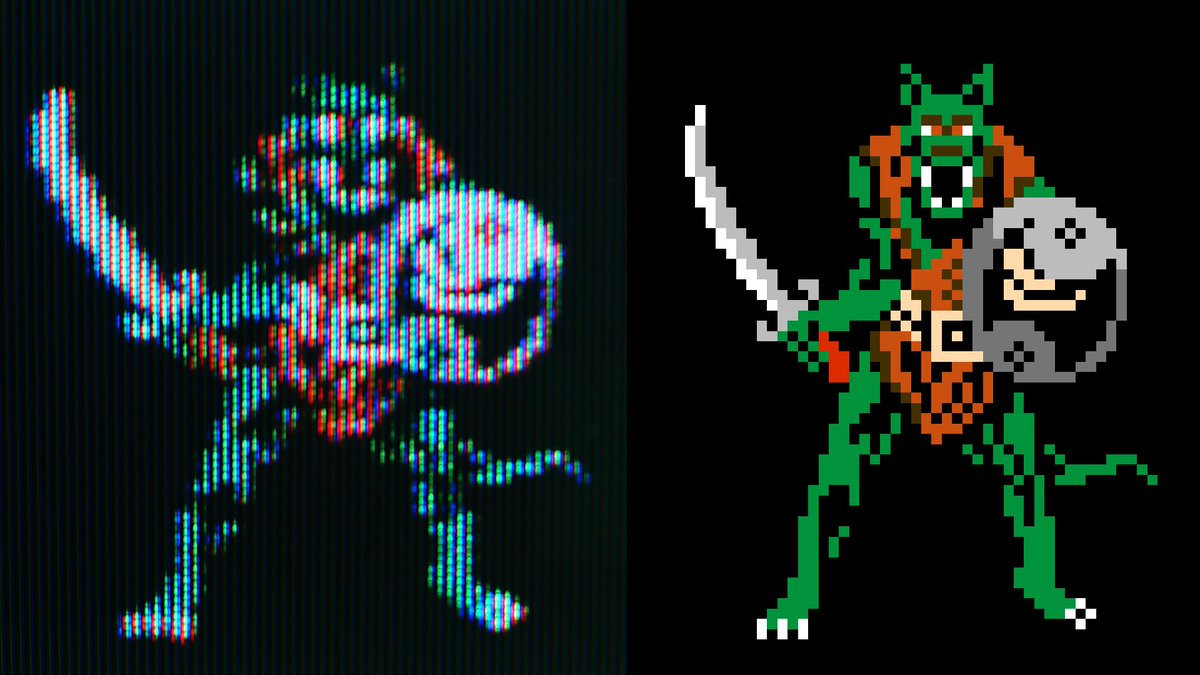
looks much more like a praying mantis head on the left side to me
It really asks for a sensitive touch when setting up emulation shaders or matching a CRT. A super-sharp Sony PVM hooked up through RGB or SCART isn’t going to do justice to these either, you’ll be just as lost in sharp edges.
These days I like to gradually ease off up on smeariness as I go through systems; 80s systems through smeary connections, 16-bit through something with better color reproduction but still soft (Genesis in particular uses so much dithering that it really benefits from being softer).
see, i was right to be too cheap to get mine rgb modded!
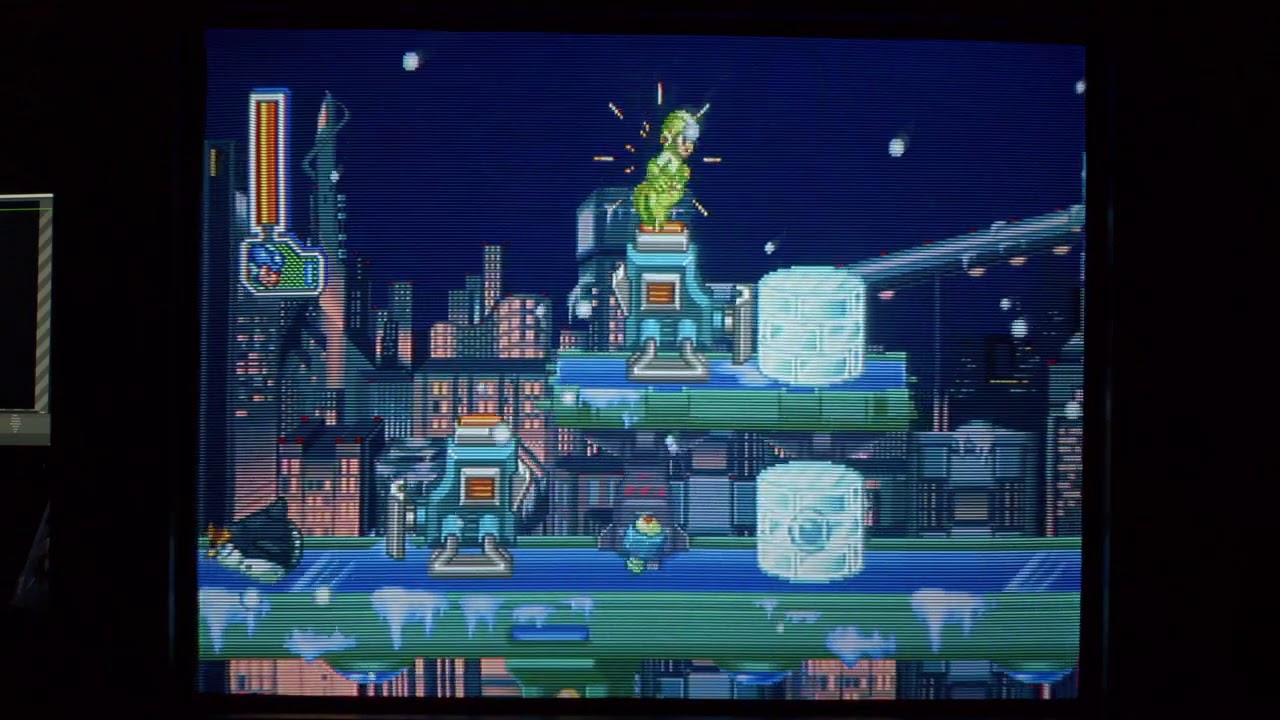
we will be set when CRT filters reach this point
i think you’re right because watching this awakened a sense of nostalgia within me i don’t think i’ve ever felt before, despite having been playing 16 bit games on emulators for many more years than i played them on real consoles
this is why a retrotink is still worth it imo – even if you’re an FPGA / latency diehard, this is more achievable with a craigslist CRT and a raspberry pi than it is with any other hardware right now
Last week I saw a really good sunset while cycling on the Bay Trail, and it was impressive precisely because there wasn’t anything dramatic about it. The light filtering through the clouds created a subtle, uncanny gradient of dim greyish-pinks on the water, and I felt I had never seen these colors before. I stopped to take a photo of it on my smartphone, but sure enough it normalized it to a “meh” sunset with familiar colors. I think it might’ve mostly come across with technology but only if I had a high-end camera, a file format with high color depth, and the viewer also had a high-end display.
In the CRT situation, the irony is that we are nostalgic for the experience of a severe limitation of display accuracy, which created its own reality that can’t be recovered with practical, mainstream technology.
i don’t think it’s always that complicated
no modern display matches the latency of a CRT. they aren’t equal, they are categorically inferior
same with motion persistence. the best you can do is state of the art OLEDs with black frame insertion, which is still inferior
only OLEDs match the black levels
what you’re saying would be tidy and clean if modern displays were objectively better than CRTs in every way, but they aren’t
which is to say that i do find it interesting, but i want to push back against the nostalgia angle when there are still real, important practical considerations
Yeah, agreed, I was mostly riffing off u_u’s reaction which was driven by the recreation of the artifacting specifically
It depends on taste, too. I moved and had space to set up my 2005 CRT with component input and I can compare it again directly to shaders & OLED. The crispness of the motion is noticeable and nice but the colors and contrast is so much better on the OLED; I find myself looking at pixel art and appreciating palette choices a lot more on the newer TV.
I’ve been trying to parse what on earth you’re talking about since last night… can you elaborate because I’m struggling to tie “retrotink is still worth it” with the second half of that (to be clear, I know what a retrotink is just… wat)