It is very satisfying how surprisingly spatially intuitive this is
this phenomenon is called holonomy right?
very interesting how it’s used to integrate rotation into sokoban design
1 Like
Yeah, holonomy!
HyperRogue DOES do some stuff around rotation, but since the infinite space makes it complicated and you’re not backtracking a lot it doesn’t come up very often. There are some zones that specify one direction as “up” and it those it’s way easier to backtrack because the camera turns so that “down” is the backtracking direction.
For this game, I think most of the puzzles so far the rotation could actually be replaced with boxes that have specific targets (e.g. colored boxes and matching targets), but that would cut out a little of the ambiguity for the player. I’ll have to see how it’s used in later levels, but it seems kind of difficult to me to design a puzzle that wouldn’t be mappable to that ruleset. I mean, there’s the trivial example where you have a loop and one target and you have to loop it around a couple times before it’s in the right orientation, but it seems harder to disguise that. I guess interlocking loops and boxes that have to go different directions with spots to store them when they’re passing?
his new game looks pretty wild too
6 Likes
this isn’t really a game …yet… but it’s making me profoundly reconsider things

4 Likes
i did not have a good understanding of what a mandelbrot set actually was until i watched this video!
2 Likes
the simplicity of the definition really makes the results much more boggling!
1 Like
Tandis is out!
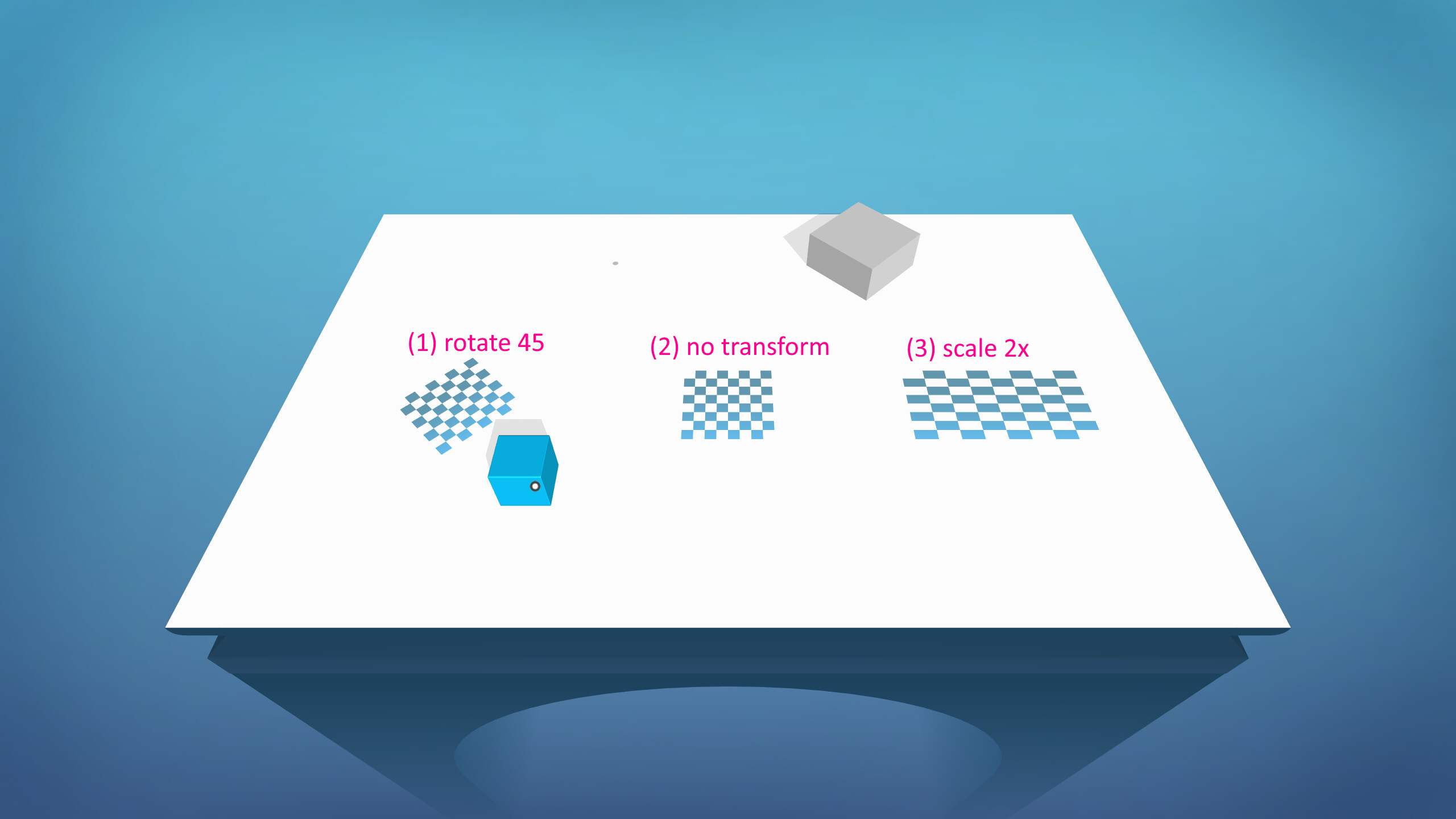
It’s gorgeous in a way you can’t tell from the trailer. It’s essentially an algebraic geometry game: you’re given a target shape, and each grid on the floor represents a transformation - scaling, shearing, rotating. By placing a shape on a grid, you can see it transformed in real time on the other shapes. By picking up a transformation, you can re-apply any transformations until you work out the target shape.
For example, in this puzzle the goal is to take a small blue cube and make it match the larger, rotated gray cube.

By placing the cube on a grid, it will appear on the other two grids with both the placed and output transformation applied. In this case, the left grid rotates I put the cube on the left rotator and it appears on the middle and right grids after applying their transformation. The left grid will rotate, the middle will do nothing, and the right will scale the X axis.
Then, I can grab an output and place it in one of the other two transforms, and get a new output.

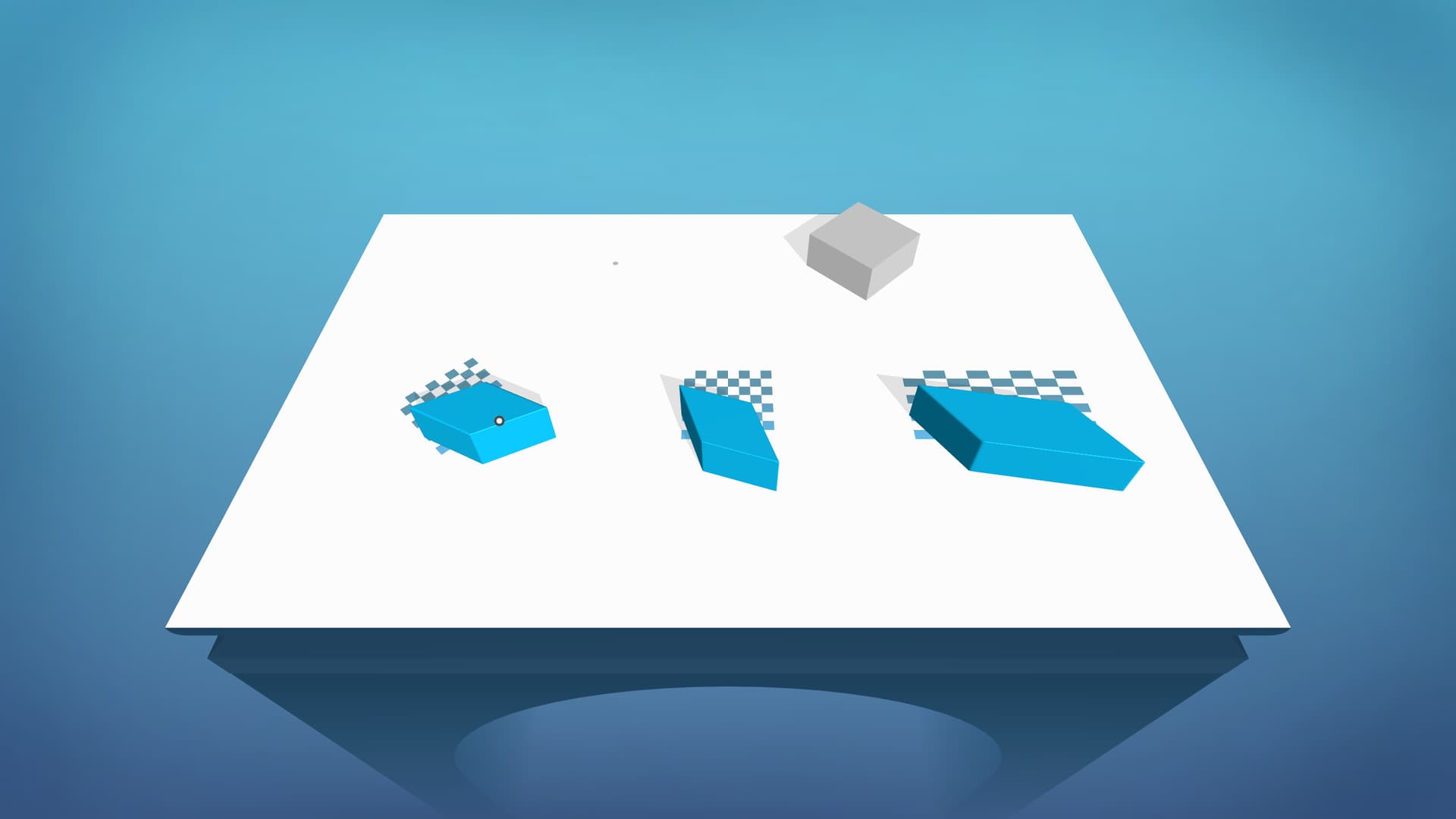
and the game has no problem if you go silly with it:

And of course rotation and scaling are not commutative so you need to understand that the solution is to first rotate, then scale, which could easily be expressed in notation.
But this is effectively a new, toy-like language for math, and it’s beautiful.
6 Likes
have been pondering if finite fields could make interesting puzzle objects
1 Like
the appeal would be limited
puzzlescript games are basically groups
yeah i mean, i’ve never even been that attracted to a rubik’s cube, but i got kind of intrigued by the idea that the multiplicative group is always cyclic (i.e. one-dimensional), while the additive group can potentially have any number of dimensions
Being able to play Number Munchers’ prime mode at last is like the real life version of finally using the double jump boots at that spot at the very beginning of the game.
3 Likes
2 Likes
your screen being swarmed by ants simulator
(kinda only works on desktop)
2 Likes