this motherfucker right here
a gateway to misdeeds
3 Likes
I dream of a new microcomputing era (one that doesn’t mostly depend on the raspberry pi foundation and the continued use of conflict minerals). Gimme my cute lil keyboard that does cool stuff!!
3 Likes
I want to make the case for Wriggler balancing cartoon innocence against a pastoral Hellscape where everything will kill you
but I won’t!

Once again linking the definitive document on computer games: Eleven ZX Spectrum Games of Interest

Batman for ZX Spectrum is playable and I proved it by setting the world speedrun record that still hasn’t been beaten (or recognized by the powers that be but that isn’t my fault).
16 Likes
I have! I still think I prefer ArcElite to Oolite, Oolite is just a little too aesthetically mid 00s freeware pc game so its not my thing as much, though I respect the effort 100%
1 Like
Halfway through reading this I realized these are real games that exist and not parodies of what Spectrum games seem like.
9 Likes
It’s probably worth saying that the Gameboy version of Robocop is a port of the Spectrum Robocop game, which probably makes it easier to play.
1 Like
Having a top 11 list and then making one of the “11 games” an ad for your own indie game that isn’t even released yet is some top-tier clickbait.
3 Likes
Ah Diddums
5 Likes
My best ZX games list
- Deathchase- there’s a remake of this and it’s good, but the original is still good. It’s pretty much the speeder bike chase through the forest scene from Return of the Jedi made into a whole arcade style game.
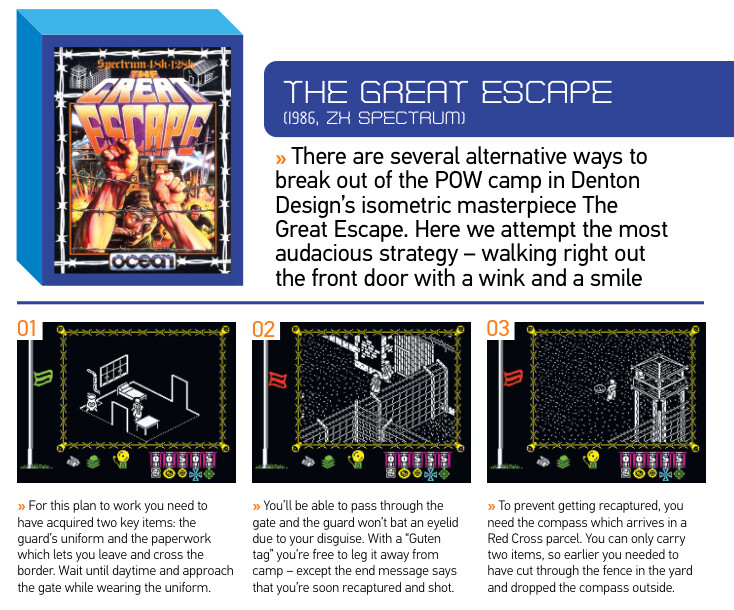
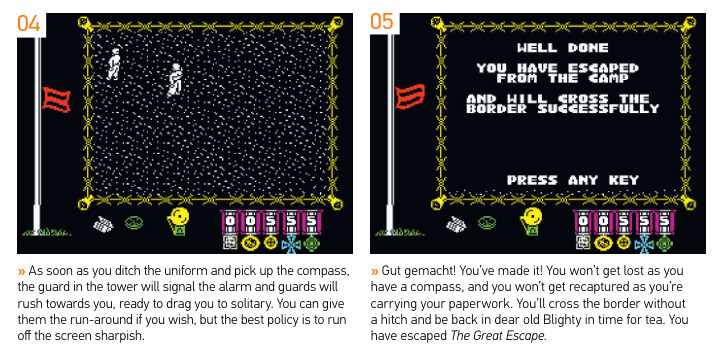
- The Great Escape- a pretty tight isometric adventure game about escaping a nazi pow camp.
- La Abadia del Crimen- Spanish language isometric adventure game mentioned by Tulpa earlier. Probably better than the Great Escape, and it has a remake worth playing.
- Renegade series- somehow this originated as a Kunio port. The sequel Target Renegade got an NES prt and it’s not good. Third game in the series becomes single plane and includes time travel for no reason other than karate vs dinosaurs.
- Ping Pong- Konami brings table tennis. It’s technically very nice for the time, worth a bit of a look just to prove that the machine can do things.
- Robocop- Play the gameboy version and know that you are playing the spectrum version minus technical jank. It’s still hard and maddening and feels very Robocop.
- The Sentinel- weird proto 3d game where you have to use stealth to avoid the Sentinel, and teleport across the map to higher ground to take out the Sentinel. Absorb energy from trees and rocks to destroy them and use that energy to make new landscape elements to move to. There’s ports that are easier to get running but it’s a definite euro weird game.
- Saboteur and Saboteur II- Ninja exploration and action. Side scrolling
There was one I played when younger that was an isometric hang giiding game that may have been a type in game. It was all about travelling from the bottom right to the upper left and trying to get as much distance as possible. I can’t remember the name of it but it was pretty neat on my neighbor’s sinclair.
Tulpa already mentioned Elite. I never got into it so I can’t vouch. I can say that the ZX had a lot of isometrci action adventure type games and arcade racing games and that was the main appeal to me, not the platfomers that looked like they belonged in some space between the Atari 2600 and the NES technologically.
Honorable mention for eurogame of worth is Exile for the Acorn and BBC Micro, which got remaid by Ovine Design and honestly a lot of games have been remade by ovine and that’s probably the best way to experience most of these games https://www.ovine.net
edit: the dl link is down on ovine dot net, not sure if they are still active
6 Likes

this 1985 Czechoslovakian 8-bit micro is so obscure, Wikipedia doesn’t even mention it
4 Likes
Retro Gamer magazine often publishes article about ZX. In the newest issue in my hand, they introduce the Roller Coaster which impressed by Blackpool Pleasure Beach, it’s basically a British local history and read with fun instead of playing with fun.
3 Likes
The magazine also mentioned that a British company made a medieval-themed Game Boy game based on Dragon’s Lair without paying developer licensing fees: Dragon’s Lair: The Legend. Wikipedia’s take on it is quite interesting, though I haven’t verified it maybe it’s also a made up.
The US version of the game received almost entirely negative reviews. EGM rated the game a 17 out of 40.[9] It currently holds a 1.63 out of 5 user rating on GameFAQs, placing it 1,052 out of 1,068 Game Boy games.[10]
Reviews of the European version were more favorable, even receiving scores as high as 93% and 5/5 stars.
As we know today, back in an era when information was not as readily available, game developers would copy and modify other countries work thought nobody knows, then promo self as pioneers of a genre and nobody knows. ZX was essentially part of this vast network, whether as a victim or a beneficiary. So pure fun of 8-bit microcomputer games may not so obviously on its own today, the fun may exist as part of a larger picture.
4 Likes
I’ll continue,
In the magazine, the author of Roller Coaster talked about his experience learning machine code, and about spending two months optimizing and modifying the program as much as possible so that the memory and processor could operate beyond the ZX limits. This ensured that the game graphics wouldn’t generated gradually step by step, but would instead appear all at once. That raises another familiar problem of nostalgia: unless you played ZX games in chronological order, and were familiar with a large number of them, it would be difficult to understand its outstanding.
Recently, I have been playing an early Square game for another 8-bit computer platform, MSX: King’s Knight . It had both MSX and Famicom ports. The MSX version is extremely choppy and the controls have a noticeable input delay, whereas the Famicom version is remarkably smooth. This kind of lag makes for a poor gameplay experience, especially for modern players. BUT it’s fascinating, because most of us have probably heard the story about Kojima giving up on making a shooting game for the MSX because the system couldn’t handle scrolling and how that limitation influenced the design of Metal Gear. I had also happened to play Undeadline on the MSX2, so I had a strong impression of the enormous progress MSX2 represented over the original MSX.
King’s Knight is an interesting case. In order to achieve scrolling on the MSX, the game manually changed the screen transition from 8×8 tiles to 4×8 tiles. As a result, whenever screen processing was taking place, the game couldn’t respond quickly to input. In the end it making the lag feeling. What put it in a difficult position was precisely the thing it took pride in.
The difficulty of these games is even harder to review. Retro YouTubers generally avoid a large number of 8-bit computer games. From a cultural perspective, these games often only looks like better Atari games, nor do they don’t have the exotic appeal of PC-98 anime art work to hype. From the standpoint of challenge, many historical reason resulted in strange control schemes and excessively high difficulty. And yet, if we watch YouTubers who are dedicated to playing these games…their channel seem to have remained trapped in 2007. And their videos display an master level of…proficiency. It is almost as if this were a specialized skill, one that allows people to genuinely enjoy games on these computers.
So how should we understand 8-bit microcomputers? I once mentioned the importance of programming in another post, because 8-bit computers gave players a tangible sense of their own limitations. And, the particular efforts made by game developers in that era didn’t follow the kind of linear progression associated with traditional video games. That makes it very easy for us to interpret them in ways that are completely different from their original intentions.
So, if we were to respond to the question:
There’s gotta be something on these PCs that’s actually good, right? I doubt the hype around them 100% nostalgia based.
The answer may be not easy to explain. Their ecosystem is more like a rainforest: multicentric, chaotic, and extraordinarily diverse. Their appeal lies in the fact that they invite participation. Viewed through the lens of complex systems: the sheer number of machines from different countries, and the large role played by bedroom programmers, shows that this system possessed a strong capacity for emergence. It had none of the platform monopolization found on consoles or IBM PC. This allowed The 8-Bit Guy to develop a C64 RTS game alongside making YouTube videos. But AVGN had to outsource development to a game studio. Although both are gamers, they are fundamentally represent two completely different kinds of systems.
Another thing I think fully highlights the differences between two systems: the 8-bit computer community is very open-minded about game development using LLM, at least it didn’t lead to a rage argument, and AI disclosure is easier as well.
8 Likes
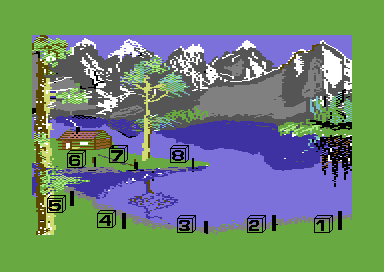
Those of you who know Jack Charlton from his days as Republic of Ireland football manager may think this game is about his habit of investigating the histories of English footballers in the hope of finding a solitary Irish grandparent so as to qualify the player for his team. In reality however, he’s also known for his love of fishing.
Up to 8 players can join in, each of whom are awarded a ‘peg’ - essentially a random position along a lake. The types of fish you are likely to face in each area are detailed before you start - pike, roach and bream are among the most common. Using this information you can decide which type of rod to use, choose your bait, and decide how deep to fish - experts in the subject will be fine here.
During the main part of the game, one of the 8 bays will flash - the player fishing form this peg must press the relevant number as quickly as possible, then watch a short animation depicting the result, which is a function of how quickly you press the key, and of whether you have the right equipment.
https://www.mobygames.com/game/19156/jack-charltons-match-fishing/
3 Likes
2 Likes
The making of Turbo Esprit, the Spectrum game set in Romford that predated GTA
Lotus blossom.
Feature by Graeme Mason Contributor
Rockstar’s Grand Theft Auto has become such a behemoth it seems strange the series started out life as an unexpected smash. Driving around the cities in that first top-down crime caper was thrilling and liberating; there was no being forced down dingy first-person corridors here, and you could gleefully ignore the game’s missions and enjoy exploring/causing mayhem in the sprawling urban environment. GTA was often cited as refreshingly original in the games press of the time - yet those of us who had been playing on our ZX Spectrums eleven years earlier thought it all played a little familiar to a multi-city adventure by the name of Turbo Esprit.
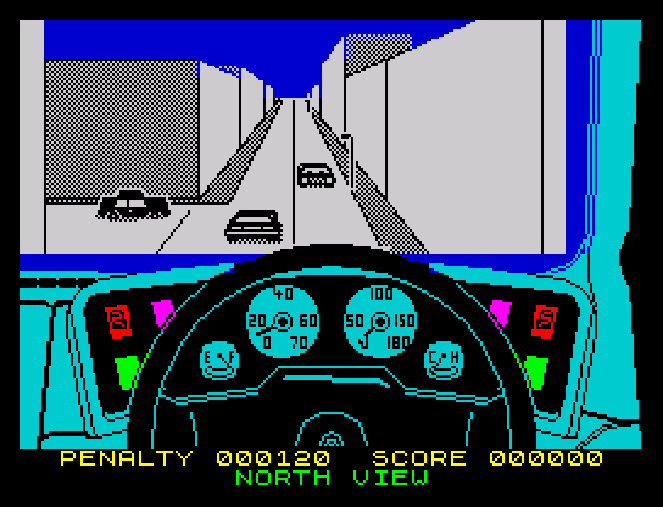
But the miracle of Turbo Esprit is not just its innovative gameplay, but the way it presents a real and suitably grim 80s urban landscape for the player to drive around, all within a mere 48k of memory. Traffic lights operate with annoying frequency, pedestrians stroll around, seemingly oblivious to the speeding cars that charge down the narrow streets and stark, angular buildings enshroud every screen. The player, assuming control of the eponymous sports car, can either take on the nefarious drug dealers or buzz around the city, obeying - or disobeying - the Highway Code to their heart’s content. Sound familiar?
The freedom to make this choice was rarely seen in 1986. “I wanted a game where you could drive around a city in real time, with the fantasy of James Bond-like machine guns to blow away the bad guys,” says Robert White, owner and founder of Turbo Esprit’s publisher, Durell Software. “So I took the parallelepiped concept from BDS to make skyscrapers in a way that a whole city block could rapidly be drawn from a surprisingly compact database.” With his experience as a CAD specialist for the Oxford Regional Health Authority, which used an integrated computer modelling system (the aforementioned BDS) to design its hospitals, White fostered the concept of an urban landscape, with the player free to move around within its confines.
When he started Durell, White originally saw himself as the company’s main programmer until the realities of running a business in a booming industry hit home. “I recruited Mike Richardson and Ron Jeffs to do the legwork - Mike already had a game, Jungle Trouble, although to start off we concentrated on Harrier Attack.” With Richardson and Jeffs producing brilliant versions of the shoot-'em-up on the ZX Spectrum and Oric respectively, Durell was quickly established as a serious player. “Computer games were new at the time, although I had recognised certain types had already evolved,” notes White. “I consciously wanted to break away from the clunky Space Invaders and platform [style] of Manic Miner.” With Harrier Attack, Jungle Trouble and Scuba Dive already done, programmer Mike Richardson had broken new ground with an ambitious helicopter simulation. “I had just finished Combat Lynx,” recalls Richardson, “which is a free-roaming 3D game, so I don’t think the sandbox aspect especially felt novel. However, when considering [Turbo Esprit] as a whole, it did register with me as being a bit of a first.”
In Turbo Esprit, the player takes on the role of a special agent, ensconced within the James Bond-esque sports car. An international ring of drug dealers are about to drop a huge shipment of heroin, and it’s up to you to stop them. Cars laden with drugs cruise around, homing in on the armoured van which is used for transportation out of the city. Upon loading the game up, there’s a choice of four different cities to choose from: Wellington, Gamesborough, Minster and, err, Romford. “I called one Wellington, because that’s where I live in Somerset,” explains Richardson. “I was a bit stuck after that - Gamesborough was because it had the word ‘game’ in it and Romford because it has the acronym ROM. But Minster? I have no idea!” However, because of the limitation of the way the maps were compactly stored, designing anything based on real towns was an impossibility, so anyone hoping to spot their street in suburban Romford is going to be disappointed.
Time for some road rage?
With the idea established, Richardson got to work. Self-employed, yet working exclusively for Durell, the three men initially sat together in one room, before the string of gaming hits necessitated a move to bigger premises. “At the start of the project I bought an Epson CP/M machine - it cost an absolute fortune!” continues Richardson. “It had two 5.25 inch floppy drives and 256k of RAM, I used Microsoft’s MASM assembler and a bit of code to download to the Spectrum via a printer port.” Despite his experience, Turbo Esprit was no ordinary project to bring to life. “There was no internet back then, and technical programming and math information was scarce and difficult for me to find. I live in the West Country, so the local library was never much help - most of the books were about tractors and cows.”
Taking the base of the fundamental drawing techniques used in Combat Lynx, the coder worked on adapting it into a combat-driving game. “Technically the 3D is based on a look-up table indexed by a stepped distance from the viewpoint. This table contains constants, mostly for 3D to screen co-ordinate conversion - these I guessed at, and modified until the scene looked right.” With the background and internal car graphics achieved through simple line drawings and fill routines, each city map is stored as a grid of junctions, the rows and columns specifying how many lanes the road has, whether it is one-way and extra items such as traffic lights and garages. Yes, in Turbo Esprit, you even had to remember to fill up, and the scale and method resulted in a huge amount of memory usage, straining the Spectrum to its limits. Explains Richardson, “Data for the four city maps was stored in the memory used for the internal buffer when loaded. Once the player had picked the city, the other three are discarded so the memory becomes available.” The result was having to reload the game should you wish to try another city.
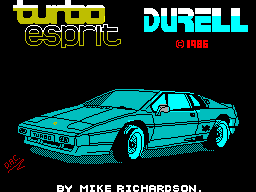
If you are lucky enough to have seen the inside of a Lotus Esprit vehicle circa 1985, it would be clear that the interior present in Durell’s game is admirably faithful, and the game’s adverts boasted of ‘technical assistance’ from the car’s makers. “To be honest it’s all pretty hazy now,” says White, “but we certainly didn’t have a licence and we didn’t get any technical support.” What did definitely happen was a factory visit and test drive early on in Turbo Esprit’s development. “They probably told us we could do anything that might promote them, but the ‘technical assistance’ claim was hokum I’m afraid - we didn’t have any financial dealings with them.” Having gone on a similar jaunt to Westland Helicopters during the development of Combat Lynx, Richardson remembers coming away from Lotus with nothing more than a selection of marketing materials which he used to fashion the game’s accurate dashboard.
Core gameplay aside, it’s the unprecedented level of detail in Turbo Esprit that most impresses. Indicators, pedestrians, window cleaners and traffic, all operating around and independently of the player - just like in the famous Rockstar series. “I believe I largely made them up as I was going along,” admits Richardson. “Really, I just did the obvious nice to-do things. The game itself can give players a purpose - if they want or need one.” After ten months of work, Turbo Esprit was nearing completion, with Richardson having successfully wrestled the technical challenges, the biggest of which was vehicle AI. “It was aided by having an internal model of what is on screen, consisting of a 2D map of the junction ahead. As the player drives through a junction, a new model is created of the next junction with the existing road then copied to behind.” The AI vehicles, rather than wandering around the whole city - far too much effort for the Speccy - existed only within this internal model. Other concepts such as a rear-view mirror and first-person view were jettisoned as Richardson tinkered around with what worked, and what could be achieved satisfactorily within the confines of the Sinclair computer.
By 1986, Turbo Esprit was ready, at least on the home ZX Spectrum version. Critically acclaimed upon release, reviewers appreciated the technical achievement, welded to an unusual gameplay. Sales, as a solo release, and part of a four-game compilation were solid, and a decent Amstrad CPC conversion appeared shortly afterwards. Sadly, on the Commodore 64 computer, things fell apart dramatically, and the game was deemed unworthy of release, save as a part of the aforementioned compilation and a subsequent £2.99 budget release, both of which were vilified. Yet despite the success on the Spectrum, Robert White wasn’t particularly compelled to even consider a sequel.
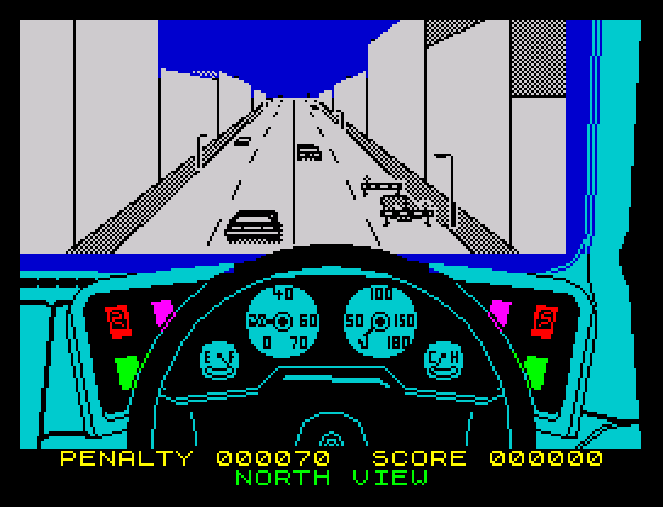
As in real life, roadworks are a blight for road users in Turbo Esprit
“It never crossed my mind,” he says. “More of the same is a bit boring, isn’t it?” Richardson, keen to develop fresh concepts for each new game, doesn’t recall the idea of Turbo Esprit 2 even being discussed. “If it had been, then I would probably have shied away from it - I preferred to do different things and was actively opposed to sequels.” Given that in his next game for Durell, Richardson had the player taking on the role of a giant rampaging dragon, laying waste to a fantastical medieval world, he certainly remained true to his word.
Looking back today, it’s easy to trace a line that slices through Turbo Esprit and continues on through Grand Theft Auto and beyond - if nothing else, for the idea of freely driving a vehicle around an open city, engaging in the game’s plot and missions as you see fit. “I think it’s probably a forebear, in much the same way that Harrier Attack followed the Defender scrolling type of game,” notes White, who has ceded control of Durell to his son these days, the company now specialising in insurance software. While it’s unclear whether GTA would have existed without Turbo Esprit - the designers have been quoted as having said they were unaware of the Spectrum game - that line clearly exists nonetheless. “I think it’s an evolutionary process, like the design of aircraft,” continues White, “and Turbo Esprit in turn probably owes a vote of thanks to BDS.”
For Turbo Esprit’s sole programmer, the talented Mike Richardson, it remains his favourite of a very impressive roster of games. “It was the most technical game that I wrote during the Spectrum days, and was really technically the pinnacle of them all with things that I hadn’t done before such as sprite masking, compact sprite mask storage, area fill and the internal map model in memory. But I’m very proud of all the Spectrum games I wrote. I really miss those times.”
My thanks to Robert White and Mike Richardson for their time.
Graeme Mason: Graeme is a writer specialising in retro gaming. He is the author of ZX Nightmares, a book about the worst and toughest ZX Spectrum games.


3 Likes
The newest issue of Retro Gamer (290) is good too, which rewinds all the games published by Ultimate and Knot in 3D, also introduces how publisher covert computer games to consoles. Maybe a little late, I finally realise the special effect of game theme by Ocean like Robocop or Darkman on Famicom, which a feature sound covert from 8-bit computer C64 SID chip style and console game developers outside of Europe seems not try to recreate them.
2 Likes