V’s around 500 which skirts it a bit, also the only one I haven’t read along with M&D but I’m fed up with him at this point, going to make a dent in The Anatomy Of Melancholy instead.
1 Like
i’ve been reading Fort Bragg Cartel and it’s been taking me a while because it’s just really heavy and kind of depressing. recommended, but only if you want to feel bad
3 Likes
The Final Girl Support Group was pretty fun and brainless
1 Like
gotta say i am a fan specifically of what i think of as Later Pynchon, like from vineland on. lot 49 and gravity’s rainbow i like a lot (could never finish v) and i wouldn’t say they’re like “bad” or undercooked but rereading them recently for the first time in a while they do seem to me to be books where the influence of high modernism is still sorta being digested - that on a passage by passage level you can sometimes feel the gears shifting from a slyer and more rangy style to a form of Good Writing (precise, polished, descriptive, characters and events described as though on high from a sardonic narrator) that sits kind of uneasily against it. to me the voice of the later books is something like a miracle just for the sense that it was able to dissolve that distinction while retaining its breadth and resources.. if the famous dfw pan is true and pynchon did spend 20 years between novels getting high and watching television then it was all for the better imo
haven’t seen the movie but did reread vineland recently as well (my partner has first go at the new one..), what a weird book, raw and unsettled even as the voice feels more unclenched. in my head it sorta feels closest to lot 49… it feels like in his more explicitly historical novels, even as they somehow avoid the traditional settled ironies of that form (ah, these poor schmucks of the past, they don’t know the REAL import of xyz which is only visible from our rarefied later viewpoint) there’s still a sense that it’s periodisation itself that holds them together, acting as some ambiguous counterpoint to the narrative. i think all his books have some moment of glimpsing an abyss but in the contemporary ones it’s a glimpse that seems to contaminate everything around it, like the whole narrative is frozen and waiting for the other shoe to drop. i’d forgotten how much of vineland is flashback or reminisce and how many of the present-day sections are just people tensely watching and waiting from the edges to see what’s going down next.
9 Likes
but which one is it??
1 Like
major. it’s major pynchon. go ahead. take my word. you can trust me.
1 Like
It’s no bleeding edge 
1 Like
I’ve read past the battle of Red Cliff in Romance of the Three Kingdoms now, and re-watched the first part of the movie. It’s funny how the movie is basically a John Woo bromance between a commander and a strategist, but in the book their relationship is framed more like Yosemite Sam and Bugs Bunny.
Like you’ll have Zhou Yu plotting to kill Zhuge Liang, but the latter will outsmart him and sail away going “Better luck next time! So long, tra-la-la!” while Zhou Yu is stamping his foot and shouting at the sky in a rage
4 Likes

Dump post
I finished Debt: The First 5000 Years – David Graeber. It was a good read but quite intensive in terms of effort. Found myself losing the thread of the argument while diving in and out of commuter reading. Graeber puts forward some good deconstructions but a lot of it is reliant on extremely extended multi-part arguments that need to be made over several chapters. Sometimes a case study or historical footnote will be highlighted for discussion with the promise that it will eventually make sense. It does, but it makes for a very difficult read in totality. Graeber is still compelling though. More of this kind of academic rigour needs more humour imo. Pretty decent attempt to integrate the history of India and China as well, highlighting the ancient and middle-age Europe’s lags and relatively slow development at times before showing up how colonialism could’ve been done differently using debt as the conversation starter. I recommend it but only if you plan are not reading anything else for a while.
After this I struggled to find a book that really grips me.
I read Preparing to Teach: an introduction to effective teaching in higher education - Graham Gibbs and Trevor Habeshaw. It’s a good book that walks through all sorts of different ways to teach university students which I mostly read for work. The main thrust is that the traditional lecture should probably just die and that there are many alternatives that are really trying to do to the teacher’s fear of upsetting expectation or losing authority. It’s good but mostly a textbook.
I then read Ways of the Hand - David Sudnow, an autoethnographer who also happens to be a skilled jazz pianist. The book is essentially about the beginning to end journey of learning how to play the piano from the very start to learning the most advanced elements of jazz improvisation for piano. I could not stick with the book once it started to get into the technical stuff and I think it’s mostly just because Sudnow is just endlessly describing what it feels like to play piano for dozens of pages without really offering many conclusions. I think this book would be more enjoyable if you yourself are a musician but as a non-musician I really struggled and had to give it up after about 50 pages.
Since then I’ve had more bad luck and am juggling three books at the moment:
1. Tomorrow and Tomorrow and Tomorrow - Gabrielle Zevin
I had this recommended to me many times by different people because of the focus of the plot on videogame development. The book follows a group of graduate students making a game together in the 90s and follows their career into success. Ostensibly this is a framework for exploring the on-again off-again character relationships as they fade in and out of familiarity. Unfortunately, the framework comes to be one of the major flaws of the book , of which it has many. You cannot read this book for long without tripping over some really wedged in videogame trivia to keep things contemporary to the current year. Characters will randomly stop conversation to muse about how ingenious a given game released in 1996 was, listing the full staff credits and describing its core gameplay loop to each other in a way that no human was discussing videogames 30 years ago. This stuff feels like it’s for the lay-reader and is just distracting for a more familiar audience. No extant videogame can be discussed casually in this book.
Not only this, most of the characters are unlikeable, inconsistent, and fairly shallow. The relationships hinge on us being told that they just like each other or suddenly decide to hate one another because of some perceived slight.
The book also stretches believability with regards to the make-up of the team. Three central characters make up the original student bedroom team: a coder/artist (who seemingly does everything), a designer(?), and a producer (for a Three. Person. Team). The game that leads to their breakout success also sounds like a very boring and pared back indie game version of Ico or a critical darling that would be more at home in the mid 2000s than 1998. Development of the game mostly consists of characters discussing ideas for the game rather than any interesting issues that actual development leads to, especially regarding the challenge of collaboration.
Later when they get larger budgets and actual studios we get no real development of characters and how they might relate to other co-workers. We only ever hear about these central characters and the faceless game developer studios which they then eventually lead do not expand the cast or complicate matters in any interesting way. The world is a miniature. Characters will discuss something about a project and then we will see something like a two year timeskip after which conversation resumes about something they were talking about two years ago as if it happened two hours ago. Dialogue and exposition provide some new contrivance or cliche on almost every page. I am very close to quitting the book but a family member gave it to me and I feel somewhat obligated to honour the gift. I’m telling myself that I’m learning how not to write a book.
There is some decent stuff around the coder artist (woman exploited in early industry culture) and several of the characters explore biraciality but it struggles to get to a really interesting place that resonates with everything else.
2. On Freedom - Timothy Snyder
This is better written and at least has some interesting philosophical discussion of the nature of freedom as well as some good history. However I can’t read it for long without feeling that the book is overly sententious and often virtue signalling to the reader. The negative and positive freedom binary feels a bit too absolute at times as it is discussed here. Snyder frames positive liberty (Ukraine and Europe being the prime example) as always preferable to negative liberty (America) in concept but this ends up feeling like a bit of a childish comparison. Why not both? Surely a mixture are important but I think Snyder is clearly writing to an American audience and is somewhat annoyed with them. The book is broken up into very short segments which are like miniature essays. I liked this since it chunks up ideas nicely but it also means that the transitions between each section are quite abrupt.
One section begins with Snyder telling us, unbidden, how when the recent war in Ukraine started his daughter donated all her money to Ukrainians without any other context. This introduces a section that’s meant to talk about recognising injustice but ends up coming across as irrelevant or lacking context, kind of like ‘what am I meant to do with this information?’ and many sections have similar transitions.
There are sections that are very well written but the book’s weakness is the same as many other pop-sci or politics digest books when they start to quickcite pop psychology such as skinnerboxes or confirmation bias. Re-explaining these basic facts in a haphazard manner ends up casting doubt on other anecdotes and citations elsewhere and just feels like a cogent and concise edit was avoided in favour of getting it out at the nexus of a second Trump presidency and Putin’s war continuing. I can see myself reading more but maybe not finishing it. There’s not really a structured throughline and the question is really just an open-ended ‘what’ about freedom rather than a clearer manifesto. This was also a gift from a family member and so am stuck in the same problem.
3. The City and Its Uncertain Walls - Haruki Murakami
Probably the best of the three that I’m juggling since Murakami is usually at least readable without feeling you have to constantly blink hard after a particularly rough passage. This book is his most explicitly surreal book diving straight into fantasy from the first couple of chapters. It’s set within a sort of alternate reality/city where people’s shadow selves live protected by an impenetrable wall. The protagonist has a teenage relationship with a girl in his hometown and the story bounces to in this perspective and his visit to the wall later as an adult to become a dream reader to his girlfriend’s shadow’s dream librarian. Actual details and exposition are breadcrumbed throughout but it’s not long before we hear about the unbearably hot boiling of the main character’s loins any time he thinks about the developing breasts of his friend. I am very early in it but it is a long one and despite being more readable than the other two, is still quite airy for such a big novel. It could go either way with this one.
Funnily enough I got this one as a gift for another family member so maybe it’s going to have the inverse effect?
4 Likes
Tried reading “The Subtle Art of Not Giving A Fuck” but its basically a 150 page reddit post and I felt myself getting dumber the longer I read it. seems like the worst thing that happened to the author was getting kicked out of school for carrying pot in his backpack and his parents divorcing. which is kinda bad but like I have been through way worse.
especially the section on Self Esteem. i had to redevelop my self esteem after learning I had cptsd so i think the whole “you’re not special” talk is stupid
5 Likes
i just assume the entire self-help book industry consists or crap like this. i have it written off in my head.
4 Likes
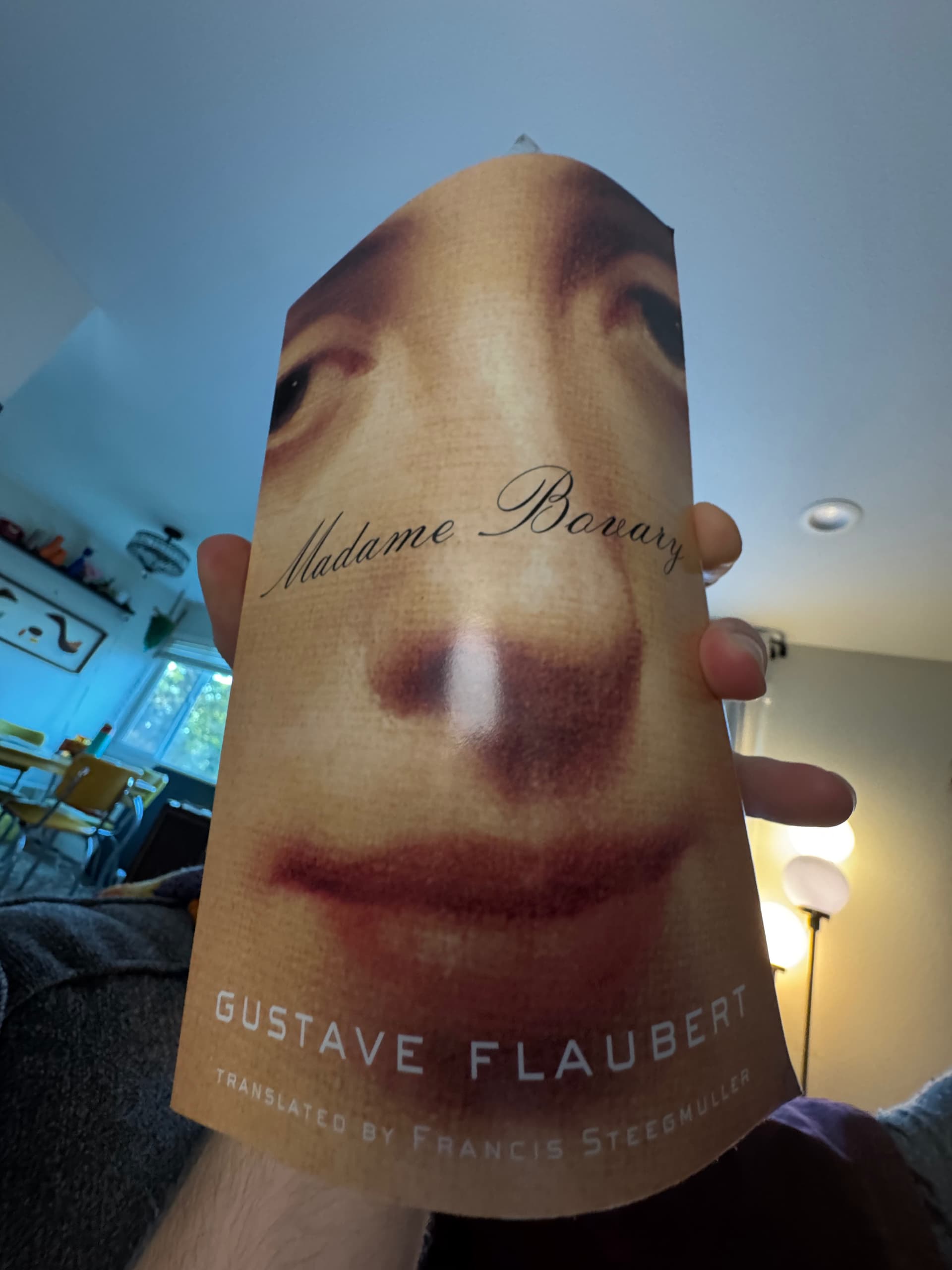
I am in the middle of Shadow Ticket right now, but a little over a week ago I finished Madame Bovary. Controversial statement, and one that I won’t bother to qualify, but I personally think the French are just great.
I am a big fan of realistic fiction. It’s a style that is so good at exploring contradictions and ironies. It is just as suited to rendering depictions of personal life as it is whole societies, making it a great method for standing up literary punching bag fools to bat around as a form of social critique. Right off the bat with this, the supposed first major attempt at the realistic novel, the French saw literary realism’s potential and wielded it just as it should have been: making fun out of the values and striving of the middle class. Madame Bovary is hilarious. There are so many moments of subtlety that show various people’s petty, cruel, stupid outlooks as the source of their own or tragically their neighbor’s frustration and misfortune. I have not looked into any conversation about the novel, really, other than learning that it was PKD’s favorite. But I suspect its ending is famous, which leaves its protagonist at her death bed, shifting focus to describe the social advancement of a supporting character, the chemist, by means of prescribing to a blind peasant an incorrect medical treatment, discrediting the poor man’s claims of malpractice by battling him in public through articles in regional papers which the blind man could neither read nor write a response to, leading to his being locked into an asylum. It ends, miles away from the main plot of the book, with something like, after all this, “he has just been rewarded the cross for the Legion of Honor.”
This book really gives off a warm glow. Not because it has a plot full of positive comfortable sentiments and scenes. There’s lots of scandalous and outrageous acts, including a sex scene I had to drop the book and exclaim “sex!? is that what I am reading about, now???”. The warm glow instead comes from hot effort Flaubert exerted in rendering such a deep picture of the motivations and pains of a deeply confused social class. If the story of Emma Bovary were true, and anyone tried making her life into a story today, I think the end product would likely shame Emma Bovary for trying to claim control over her boring marriage or for having aspirations that tend toward pleasure and self-gratification. But I think Flaubert’s focus drives us past these sympathetic desires to highlight how in her heart of hearts Emma Bovary was a cruel and selfish person who found company and then accompanying pain in a group of people (men and women) who were exactly like her in almost every way.
I watched a film adaptation of it, too. The director of Story of Women, French guy named Claude Chabrol, where Emma is played by Isabelle Huppert. And it’s a totally serviceable and nice looking adaption, but surprisingly staid. I’d still recommend it if you’re not likely to read the book, or if you already have and liked the story enough.
And Shadow Ticket is just alright so far. I can’t believe I am more than half way through and… have so little to say.
5 Likes
Oh I neglected to say that Isabelle Huppert is obviously the best part of the adaptation I mention. The death scene at the end? Expect amazing things from her performance. Count on that.
I should also add that reading the letterboxd reviews for the film–you wouldn’t be surprised by this, i’m sure-- but it’s funny to me and not totally incorrect for people to be saying shit like “yaaaaasss queen Emma!!! slay” about her most desperate arguably manic behavior as she digs herself more and more into her own grave throughout the story. It is kind of bad ass, disregarding “commonplace morality”, to be sure. Wouldst thou like to live deliciously, and such. Though I think if you leave it at that you kind of miss probably the thing about this book that remains terribly terribly effective as ever, which is that criticism of middle class ethic.
2 Likes
This is the problem with like 85% of all letterboxd reviews lol
2 Likes
it definitely is. we’re all just there to be silly. and we’re all just writing the same review over and over. it’s kind of funny in its own stupid way lol
2 Likes
i had to stop taking that site so seriously after they deleted my review of the louis theroux israel documentary because i was too mean about israel and some zionist reported it. in fact they’ve taken down several of my reviews because I accuse the director of a movie of being a misogynist etc and the funniest case of this is the french director who got his start making gta4 machinima and goes out of his way to report every review me and my friend put on his racist and sexist movies… at this point if i’m going to seriously review a movie i’ll just post it on here cuz people on here are way more interesting anyway
3 Likes
Tomorrow and Tomorrow and Tomorrow is finished and it’s a miserable book. I started bookmarking every page that had some writing on it that made me want to scream. Enjoy.
She leaned in to kiss him, and he kissed her, and then she put her hand between his legs, wrapping her fingers around the cylindrical chamber of blood sponges that was his (and every) penis. He felt the corpora cavernosa, commanded by nerve messages from his subconscious brain, fill up with blood, and the tunica albuginea membrane, the penis’s straitjacket, trap the blood inside.
Below, the author attempts to write game review copy from the year 2000 and seems to be somewhat naive about the tone of games journalism at this time. I only bring this up since there seems to be so much work spent trying to paint a semi-accurate picture of game development at this time. The other problem is we never get a real sense of what the player does in any of these fictional games. It doesn’t ring as authentic or interesting though I suppose this indirect perspective where you don’t really have all the information has potential.
Although professional reviews did not entirely determine a game’s fortunes
in 2000, the reviews for Both Sides ranged from mixed to bad:
“For those of you who have been eagerly awaiting the next release from Mazer/Green,
let’s get this out of the way: Both Sides is not a game for fans of the
delightful Ichigo series.”
“Some of the graphics in Myre Landing are among the most beautiful
visuals I have ever encountered in a game, but unfortunately, Myre Landing
shares space with the maudlin Mapletown.”
“While I enjoyed aspects of my play, the game is twice as long as it needs
to be.”
“Both Sides suffers from a major identity crisis.”
“Ichigo fans should skip it.”
“…the game seems schizophrenic, as if it has been designed by two
different people, and the play is unsatisfying.”
“The weather in Myre Landing is the best character in it.”
“The game’s ending is twice as clever as it needs to be.”
“We can all agree that we need more games with female MCs, but I didn’t
like either Alice Ma or Rose the Mighty.”
“Ichigo is so different from Both Sides that it is hard to believe that the
same set of designers made it. Maybe Ichigo is more Mazer’s game, and
Both Sides more Green’s? Mazer, usually the more public of the team, was
curiously absent during the promotion, while Sadie Green was definitely
front and center. Maybe Mazer knew he had a flop on his hands?”
“Both Sides thinks it’s blowing your mind, but mainly what it induces is a
minor headache.”
“I guess I was expected to feel emotion at the end of Both Sides, but the
only thing I felt was the strong desire to throw my controller across the
room.”
“There is so much technically right with Both Sides. Amazing graphics in
the Myre Landing section, a haunting score by Zoe Cadogan, great sound
design, a reasonably clever concept. So why did I hate it so much? Because
it’s pretentious, it’s boring, and it’s not that fun. Better luck next time,
Unfair.”
This one drives me, unreasonably, over the edge
Marx thought it would be helpful for some of their creative team to be present at the
meetings, which were about the possibility of Unfair [protagonist’s game dev company] collaborating with Morikami Publishing to adapt the popular Osaka Ghost School anime series
into a game. Morikami was interested in working with an American partner,
and they liked Unfair because of the work they had done on Ichigo, which
seemed to be agreeably Western and Eastern to them.
[… the next page …]
They spoke of whether Tokyo Ghost School was something Sadie and Sam
would want to work on, if Morikami made them an offer. “Maybe?”
The pinnacles of 2009
“I’ve been trying to do something in AR. It’s hard to make AR work, but
someone’s eventually going to do it, and then people won’t want to play
anything else.”
“I disagree,” Sadie said. “People play games for the characters, not for the
tech. Have you been playing anything great?”
“Bioshock 2,” Sam said. “Great world building. Visuals, fine, that Unreal
style. Heavy Rain does amazing things with point of view. Braid is brilliant.
I was jealous the whole time I was playing. I kept wishing we’d made it.
Have you played it yet?”
There are many more but I’m done.
I finished On Freedom and its tonal problem doesn’t really abate but I think it’s got some good stuff to say on oligarchy and Snyder’s coinage ‘sadopopulism’. You just gotta wade through some waffle. There are probably many better books on the subject.
Truckin’ along with The City and Its Uncertain Walls. A little too much of the dialogue is highly literal conversations where characters explain things in great detail and the other person repeats paraphrasings of said explanations, always in perfect agreement and clarity. Half the time someone will say something like ‘As it was I’m sure you felt like your horrible marriage was like the way a young cat would get caught up in a twine ball and their owner would have to untangle things’ and the reply will be ‘Yes that’s exactly it’. Or someone will proffer ‘So you sold the deed to your house hoping to lure the ghost who was haunting your basement out into the woods where you set an exorcism trap?’ and the reply comes ‘Yes that’s correct’.
This is probably one of Murakami’s slower and more boring books. The supernatural element starts pretty heightened from the beginning so when the protagonist moves to the sticks to work at a library, the predictable tragic stories that get uncovered and the dullness of the surroundings are felt pretty strongly over the first 250 pages. It might all climax into something special and I wouldn’t say any of it is particularly bad as such but he’s crammed more of interest into shorter stories.
4 Likes
tomorrow &c was chosen by one of the book clubs i was in (because it was an official recommendation of some sort from the chicago public library system) and i bounced after like 2 pages because i didn’t feel like hate-reading anything. went to the book club anyway and the only two people who kind of liked it had literally never played videogames and enjoyed the author’s similarly-informed speculations about what videogames might be like
2 Likes