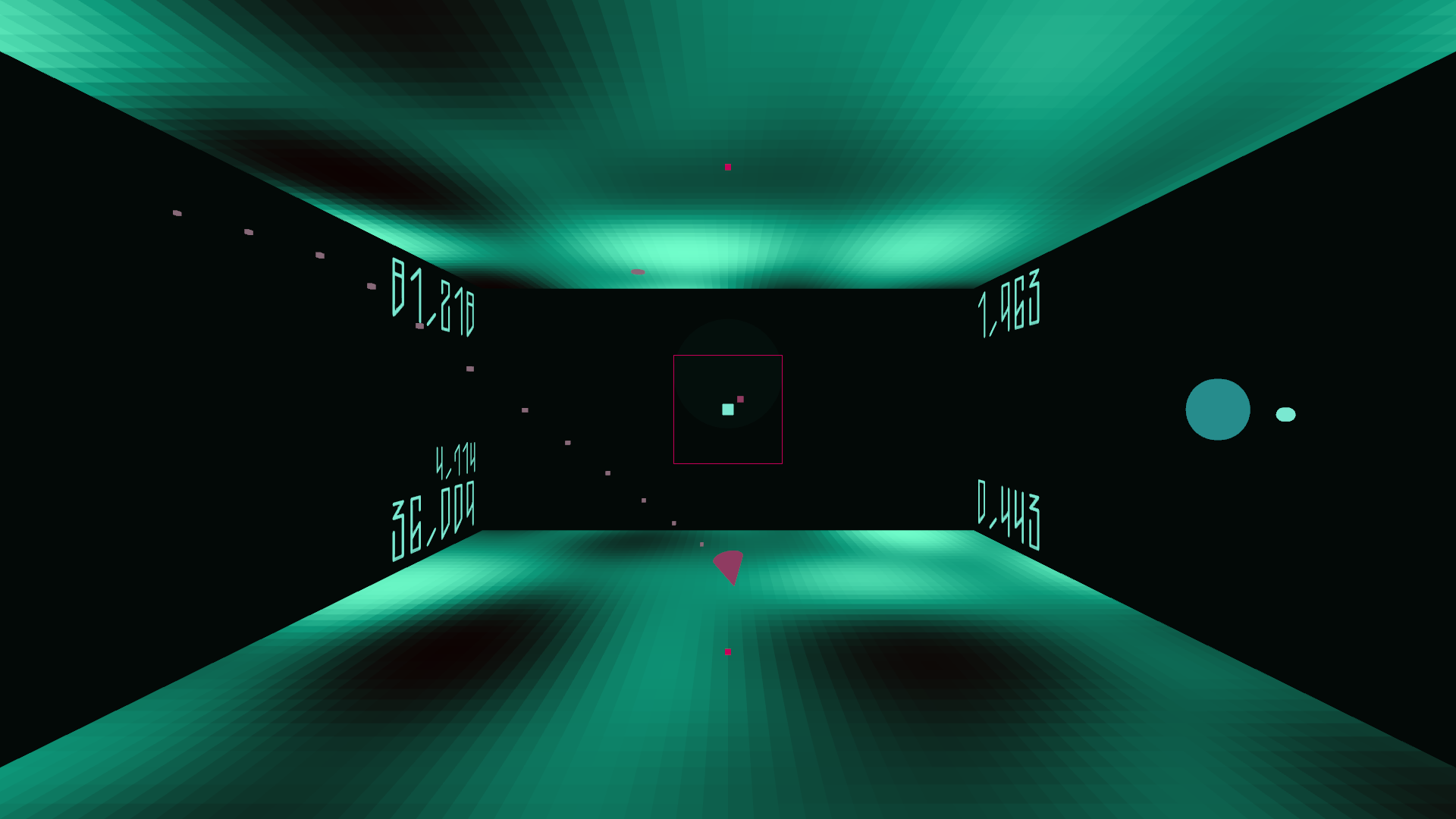
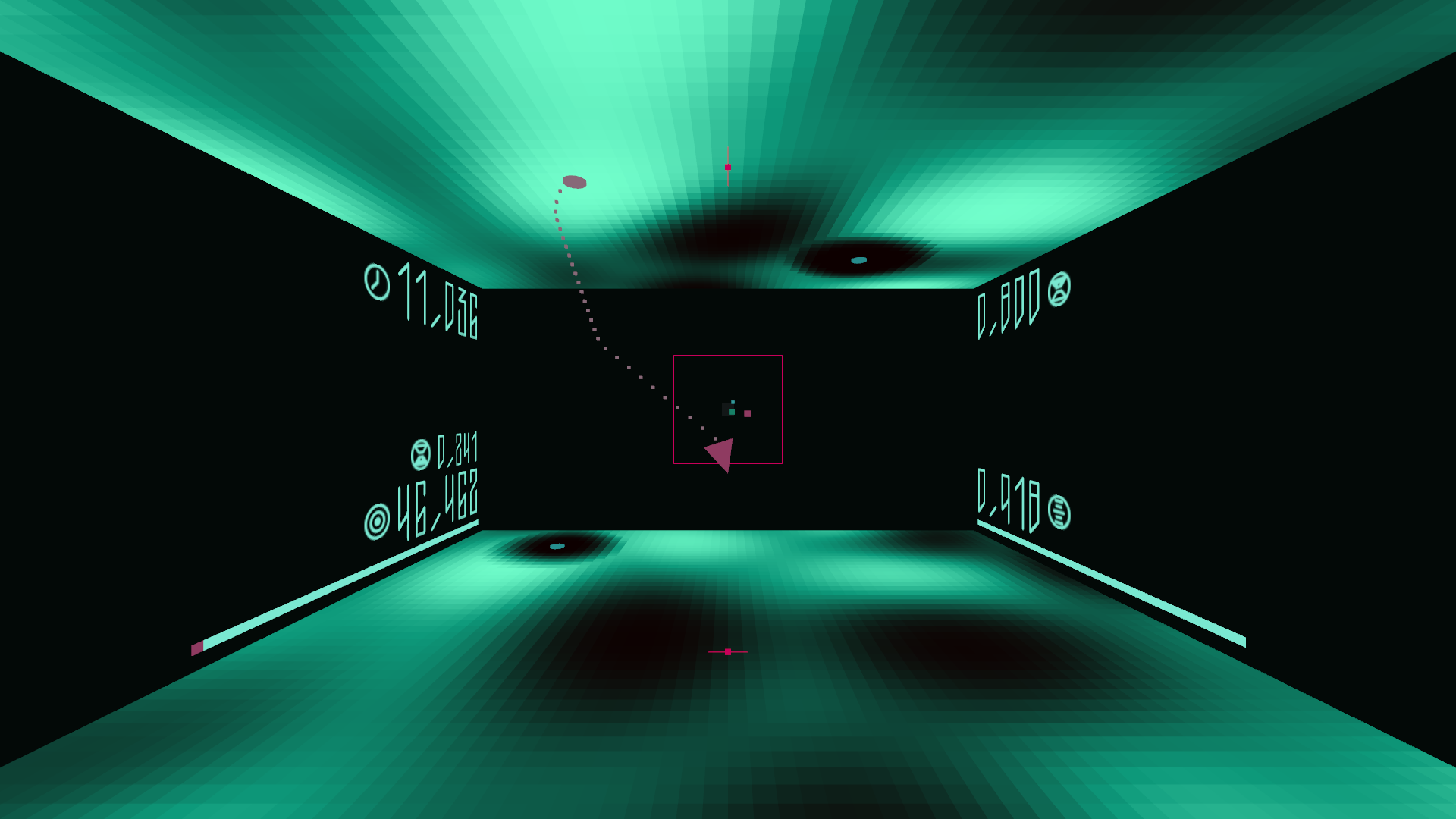
Here’s a list of common “avoider” components that are all really interesting but also we wanted to make a game without them:
Failure/death. In most avoiders, learning is cut short by death, so the best way to do well is to already be decent. We were curious what would happen if you had more time to futz around. Sea Salt City (as recommended by droqen) is an inspiration here.
Limited gamestate. Many avoiders are approximately “atomic” in the sense that the gamestate at 10sec could be identical to the gamestate at 100sec. Designing DJ Jimmy Shimmy plastered within us a permanent image of a larger-and-larger web of radial gradients, your character coasting along the intersections. (It is a verbose image.)
Short runs. We wanted an avoider you could play a single time and be satisfied with. Less emphasis on high score helps too.
i love the look and the sounds and the story/context at the beginning. i’m not sure i completely understand the game yet. i think i get the basics but it feels like a lot of details are eluding me. the spacebar/rewind thing is a mechanic i feel like i basically don’t understand at all.
if you want a nudge on how that mechanic works: try nudging the drill a teeny bit and then retracting.
explanation: the direction and amount you hop once retracting is the opposite of your drill’s final location (the drill hits the cube and the cube recoils). during the retraction, punctures begin to affect the density of the surrounding material (the actual fracking happens). since lower layers scroll faster, there is a 5 second penalty for retraction.
the mechanic is notable because: the density of the layer above influences your drill’s speed. to maximize predictability/reproducibility, try to minimize how far away your drill travels, such that you can utilize the lower density around prior punctures.
Increased density skew and drill speed factor: low-level play is now more erratic, and high-level play is now faster.
Decoupled density skew from density display skew: this should give more definition to bright and dark spots.
Decreased drill speed of the top layer.
Improved retraction randomization.
Added a hopping direction line to the hopping HUD.
Reduced the distance scaling applied to the hopping HUD.
Added HUD elements that indicate prior punctures.
Added lines to the top and bottom pink dots.
Disabled hiding the top pink dot at the top layer.
Changed the color of the middle control dot from bright blue to dark gray.
Our development loop these past couple of weeks has looked something like this:
Discover an interesting systems interaction →
The discovery improves high-level strategy →
“Strats for sickos” become feasible enough to draw attention towards →
Making the relevant info legible reveals another interaction
v1.7 happened when we realized that the orbit system was redundant with the most common failure mode of high-level strategy (unstable equilibrium around the lander coords). Removing orbit scrolling let us speed up the drill, which makes a theoretical-best strategy much more ambiguous (yay!).