Played two ~5-hour exploration-type visual novels by small dev Tsunousagi last week:
Uwagakiai
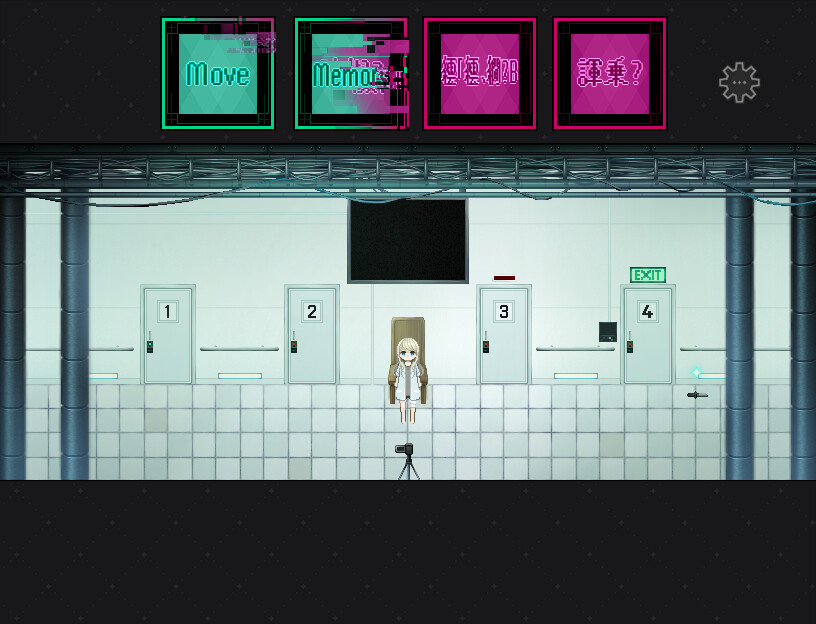
A peculiar title that could be translated as “overwrite struggle”. You awaken in a deserted laboratory in an unfamiliar body, seemingly alone and seemingly free to explore. The tutorials on the buttons at the top of the screen are full of pixel corruption and gibberish text. It soon becomes clear you are not fully alone after all – the mad scientist who has put you in this sick experiment has implanted their mind alongside yours within your own skull.
The four buttons on the top of the screen double-up as a kind of psychic HP: certain things will cause the villain to overwrite more of your mind and take away available actions (it’s game over if you lose the “move” action), while others will strengthen your willpower and turn them green again. Occasionally, your character will say or think something out of character – that’s the villain trying to infiltrate themselves further into your personality, and when you spot it, you have to object by slamming the Action button.
This system isn’t as punishing as it sounds and it’s mostly there for flavor, but it’s some pretty cool and ominous flavor. Like, the very first item you pick up is a sharp knife lying for some reason in the starting room of the game, and it’s more than a little concerning to carry that around, knowing you have an evil split personality. A little later, you are given the option to store it outside your inventory, and it felt like a weight was taken off me when I did.
The game tightly paced and gradually dribbles out bits and pieces of (alternately gruesome and heartwarming) information that, at first, make the scenario actually make less and less sense. Then it all gels into a coherent resolution in the normal ending, then a different coherent resolution in the true ending. Except for some lateral thinking called for to see the true ending, the puzzles were mostly pretty simple and none of them ended up requiring the detailed notes I took on all the murdered laboratory employees’ shopping lists and surgery scars, but those notes were fun to write anyway.
Shinya 1-ji no Koukanshu (The 1 A.M. Operator)
“Have you heard the rumor? If you call a certain number at 1am, you will be connected to a person called the 1am operator. This person is said to be able to connect you to the past.”
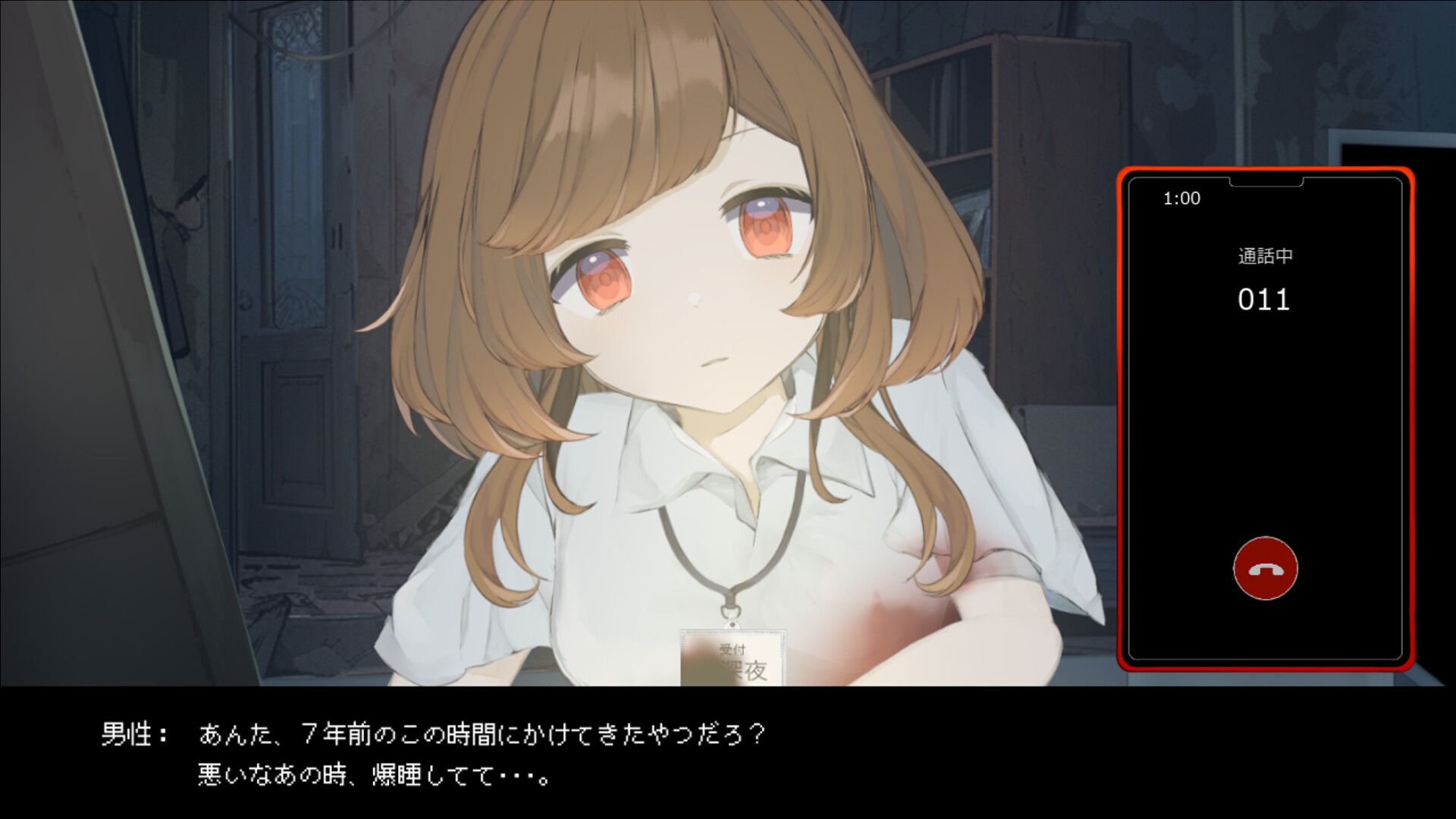
Phoning random people at 1am felt awkward at first, but before long I got into the flow and dialed dozens of numbers in rapid succession like a total maniac. Strangely enough, few people seemed particularly annoyed by my calls: instead, they seemed relieved to hear a voice they could vent their life problems to.
This game does a great deal with few art assets, turning its limitations into strengths. The only character onscreen is the titular “1am operator”, gently breathing with a neutral expression against a dark, ruined backdrop. The only UI is a feature phone whose clock stays forever fixed at 1:00. And the only voice acting is when she politely recites a standard message (like “the number you have dialed is no longer in service”). Among other things, this restraint means that when the slightest change does happen onscreen, it feels momentous.
And behind the phone numbers is a cast of a dozen major characters and countless extras, all existing purely as text on the bottom of the screen. Typically they aren’t given names, but they have their own tragedies, social networks and family trees that I noted in a text file as I played.
The same dev also made a game called
My Exit, which presents itself as simply a pixel-art clone of Exit 8, so I didn’t try that one yet. But after playing the two games above I’m pretty sure that’s just the first “layer” of that game, and I’ll try it next.
 and you can’t revise their meaning anymore. I’d like to believe it but I doubt the game is mean enough to lock you into a specific meaning just because you talked to Huang one time and he said “yeah that word looks right”!