This all ties back to an old ic/sb canard that has been proven ever more true over time, which is that very few people, and certainly none of the people who control the flow of money in the games industry, have any idea how to make a good game. That’s their gambling, the seemingly-random process of hiring 250 people and paying 200 million dollars and seeing if anything decent comes out the other end. Since “just make a good game” is the advice equivalent of white noise to them, they look to all these proxy pseudometrics of quality instead.
15 Likes
Cubes, of course they don’t want to make “good games”. As noted in the linked article, 98% of all the time and money spent playing games is spent on a number of games you can count on two hands. People who are actually controlling the flow of money want to make one of those games, and that’s it.
(And of course carries the assumption that a good game necessarily makes money.)
2 Likes
I think I’m actually of a counter-opinion in that I consider Hades / Balatro to have quite a high skill ceiling, specifically for players who seek to maximize their victories (as opposed to “just win a few times”, which can be achieved with pure chance). Hence the “stake” increases that apply modifiers that require thinking about the game differently. They’re also better about providing you with winnable scenarios than, say, Binding of Isaac, which had zero guardrails for keeping you from suffering terrible seeds.
Vampire Survivors however I can agree has basically the lowest skill ceiling a game can have, and is trivially easy to beat over and over. I think it does quite a lot that’s interesting and smart (how weapons are designed, map secrets, etc) but it’s completely lacking in skill expression and past your first win or two is basically about exploration more than winning.
I definitely agree with this, and your later statements about “work that is an end in itself” (autotelic) and mastery. To me, flow ideally springs from essentially the “confidence of mastery”; you are presented with choices and you make those choices quickly and confidently, almost automatically, because your experience is so vast that you don’t need to actively think about what the right choice may be. Of course, you might have that confidence but it’s unwarranted (like dying in DoDonPachi), but that doesn’t detract from the moment-to-moment decision-making you’re doing.
This is a little tangential, but: I tend to think about games in this way, as a series of tests and lessons and decisions, thanks to life experiences with game theory, and I think that it’s a good way to model how-why people make those decisions. But what makes something ~good~, what makes it unique or interesting, can’t be mathematically plotted in the way that an optimal strategy can be. It’s more experiential / exploratory and less didactic, more willing to engage one’s curiosity and capability for surprise.
We can (but shouldn’t) scientifically determine the dopamine responses and reward schedule to make someone play World of Warcraft. We can’t make them enjoy it.
13 Likes
i had been drafting some sort of response / thoughtmappy piece after seeing a lot of the droqen ‘kill gameplay’ stuff and really the crux to me is that game design, as an act, or practice should be more about simply solving the problems that stop you from releasing the game, ideally in a way that continues to support your rhetoric, and less so about achieving any sort of end result with a player. i don’t actually have a blog or anywhere to put longform writing, so these were some of my compiled notes
- droqen ‘kill gameplay’ asks why or at what point should a game put up resistance to the base fantasy, what is the moment in which i as a player am shown a barrier between the actions that have so far felt natural to me, and my intended result, either via a resource system, a skill check, or a gate etc. i think in a sense this does describe a type of ‘flow state’ though its one very narrow in scope and more about self-direction than being ‘whisked away’ by the game mechanics. i believe all their writing on this ultimately suggests that we seek out what the core rhetoric is for the game and stride to eliminate all elements of ‘design’ that aren’t load-bearing.
- the act of game design has always been a problem-solving task to me. the core of any game is some form of rhetoric but that is only held together by an interlocking set of systems. deciding the manner in which these systems connect or overlap, and how well they reinforce your base rhetoric is why you design. when the complexities or limitations of a ‘video game’ distract a player from the base rhetoric, you use design to bridge those gaps
- we often excuse (or accept) what we might normally consider bad design in a game that we (relatively unanimously) enjoy by understanding how the questionable aspect justifies itself within the greater rhetoric of the game. This is often how we talk about topics like difficulty, or any game systems we just consider archaic by modern standards. or we say it’s “charming” regardless of quality and leave it at that
- so when we can admit that there are useful or even necessary elements of bad design why is it so imperative to figure out all these ‘tricks’ like filling out a checklist of what to or not to add screenshake or whatever to. if we can accept that certain antithetical elements of design might be core to the idenity of a game it feels counterintuitive to try and focus game design as a craft about raking off any and all game features that might alienate or disengage a player
- the insistence that a better designed game will make players engage more is driving design up a wall and encourages developers into further and more rigid patterns. we have drawn a line where a good game is fulfilling but a successful game is engaging
- roguelikes were a novel game design tool that are now relevant because of changes to games media; streamers, daily run ‘vlogs’ type content. speedrunability. gaining prevalence in these formats became a side effect of the challenges roguelikes solved surrounding content/asset complexity and game length, but the importance is now reversed. the game requires the feedback loop in order to drive content creators to sustain your release for you, because it only “works” if there is some reason to engage perpetually.
- genuinely i think it was just nuclear throne and minecraft that cemented this idea an indie game could have a Specialized Guy that is simultaneously reliant on your game but also your own lifeblood as a developer. and a lot of this skinnerboxy, juicy indie games design is just a response to the fear that these guys are the only way you’re going to be able to pay rent.
- id like to think that a lot of developers are thinking about the above in a humble sense, that they recognize these are some dark patterns which may or may not be unfortunately necessary. sadly i don’t think its true. popular games are being made by numbers weirdos: Game quality is all that matters - a327ex
- i hate that we really put game design on a pedestal at all when it comes to these things, like “how vampire survivors makes you keep playing” type “game design content” that just completely presupposes the idea that this is something we actually want from games. in general this type of analysis focuses on this weird idea that “good game design” is something that elicits a good response and bad design a negative one, and that this is the only axis of measurable experience, like there is some imaginary fun meter above everyone’s head to manage. i think this is where a lot of the flow state stuff comes from. too much looking at games as all having the same shared metric as opposed to agents that carry out any sort of individual goal (say, for example, my beloved Rhetoric as per above)
- what i feel like is missing from any of this design critique is any amount of thought put into figuring out what the precise goals of the design were, ones unique to that game. did the design effectively carry out what was intended. i am thinking about this piece about Far Away Times: How To Make Good Small Games - and the framework of trying to outline what ‘promises’ (as the article coins) are being made and evaluating which ones are made good on and how so, rather than some standardized lens of player retention or flow or ‘game feel’
- maybe what we should be looking at wrt flow state in terms of actual usefulness is what moments are even best served by it. what moments might there be good reasons to rip it away and can doing this further support the game’s thesis. the fish factory segment of edith finch is what first really came to mind here
- while im at it i may as well as well add that the ‘juice’ thing has absolutely lost its edge. i feel like its far too common for people to treat game feel as a challenge that is resolved by running into the right guys twitter thread and applying all the same squash/stretch tweens until every gamejam platformer has the exact same language of motion, like how all the disneymarvel movies morphed into one format over the 2010s. theres a total lack of any introspection on what may actually serve the game and instead is just trying to appeal to r/gamedev commentors ahead of time
- what is confusing about it is that so much of this type of discussion seems to ignore or circumvent trying to level with the developer on any front, which feels sorely needed on so many more of these smaller games that really do center their creators. so when the game is considered frustrating or unfun there is no attempt to understand whether or not there is any element of that design that may have intent, much less whether that intent validates the choice being abrasive or not
- we need to accept that essentially every game design choice is necessarily selecting for and filtering out players, even the highly regarded principles we tend to consider praxis. i suppose what a lot of this idea of cultivating design as a practice has been in order to broaden that selection as far as possible within whatever genre constraints you are working with. there is absolutley still utility to narrowing these filters with design, and connect deeper to those that make it through, but its one of those things that only applies if you have no interest in using game development to, say, eat.
- i am thinking about the GMTK game as an example of how this heralding of ‘design’ leads to essentially no result at all. it doesn’t feature any really dark patterns but it was interesting to me to watch someone who’s supposed entire thing was game design release something with the only draw being ‘try out the game by the game design youtube guy’ which all i can really say is endemic to this idea that practicing “elevating design” really doesnt have any benefit. i think i would have taken significantly more interest in seeing the release of however many broken prototype things he made before settling on ‘flash era puzzle platformer’ conept in the hopes they would be a little less sterile
i feel like a lot of these bullets could use references to some actual examples anywhere in our Wide World of Gaming but a lot of what i had come up with in that direction felt a little handholdy and would easily quadruple the length of it all
17 Likes
I guess I don’t get the problem.
Vampire Survivors is a fun game for awhile then people tend to put it down. Balatro works because it’s not too deep. Having heard from people who don’t know poker, it actually comes together in more interesting ways if you don’t start with the shared language.
What I’m lost on is that’s better? What’s supposed to be healthier?
Tetris? Also repetitive and keeps you going back for another round. Jrpgs? Usually not that deep, often people can grind though.
EDF? Shooters? Fighting games?
What you find fun and your push for mechanical depth is going to vary. Many who dig in on Vampire Survivors or Balatro are more “casual”. If you have a more refined sense of video game mechanics of course these games are simple, you seek more complex.
But where that sweet spot is often can not be agreed on
To the gambling angle, well yes. These games use skinner boxes. But to effect. I get why that’s not for everyone and can be psychologically uncomfortable. But for similar yet different reasons I find Pikmin super stressful and have sworn I won’t touch it again. That type of game is horrid on my mental health.
So in short, different strokes I guess.
scientists have discovered since the eighties the only good type of game is something that is usually called, like, “bebos plum world” and its a game where you are playing some sort of rolling creature that can’t float in water. find warp pyramids to access echelons of the elusive “sleeper area”. oh no! spikes cause bebo damage. in japan bebo is armed with a gun but that did not fit the taste of the western market. if you touch every kind of fruit bebo looks towards the screen and thanks you personally for trying your best. there are no emergent negative patterns because you are only allowed to play bebo on saturdays after your homework is done
15 Likes
Seems like a tension in game design goals here where the designers say ‘let’s see what happens’ vs ‘let’s know what happens’.
5 Likes
god yeah i’ve been tipping into freecell lately
1 Like
All of Zach Gage’s solitaire/poker variants have gotten a hold on me in recent years, eventually I have to delete the apps off my phone so I’ll play something else
3 Likes
video games lost their way after we retired the archaic concept known as “lives” and just let players beat their heads against the wall indefinitely instead of cutting them off
“Game Over” is equally about giving the player a moment of not playing as much as it is getting the next player onto the machine (of course, relating this to arcade games is a misfire as the goal of arcade design is to keep play times down and achieving that goal by beating the player into a pulp. or having players beat each other into pulp.)
I promise you that I fully read and digested the thesis of this thread and understand it completely (he’s lying)
ironically, with gacha/phone games, the central nexus from which modern dark patterns are borne and exploited, I find the energy systems help me engage with the game in a healthy manner, a “okay, I’m out of my daily pittance of gameplay? off to go do something else. fun 5-15 minutes.” kind of hit, while also recognizing that there are people who just as easily feed money into the machine for more like it was a continue
I also relate to that flow state of playing for the addiction of play itself. sometimes I’m goal oriented and I want to do X task or beat Y level, sometimes I want to play for the sake of engaging with the game itself
I also know myself and I don’t ever play a game without an overlay with a clock on it
14 Likes
also now that I thought about, let’s blame modern multiplayer matchmaking too
why find the right server community or arrange with your friends when you can press a button and have a match spit out at you
8 Likes
This in particular seems like a positive, but I personally find it an insidious sort of evil, a dark pattern masquerading as a courtesy. It’s using the design of “play thirty minutes, forced downtime” to enforce a routine, which develops a habit. Usually these downtimes vary depending on the mechanic, so you come back 3-4 times in a day and also daily, which means you’re actually losing more time to the game than expected. And, of course, they monetize removing the downtime to suck dry the addicts who need to play continuously. Best of both worlds! You get to form habits among the non-addicts and stick your hand in the wallet of the addicts!
God do not even get me started on this, the loss of discoverable player-run community servers did so much damage to the social fabric of multiplayer gaming.
2 Likes
engaging with videogames to begin with is inherently a pointless and unproductive act so anything that forces a routine that gets one to stop playing sometimes cannot be considered evil in my book. like its probably too late, because theres 1500 little games that only want five minutes of your time but ill never fault a game with limiting how long you can play it, or telling you to do something else, i just wish those timer limits were actually hard limits you couldnt pay through. go all the way. take away my controller!!!
7 Likes
good idea imo…
4 Likes
Rallying in a sim rig is great for me because I hit a flow state, but physical/mental exhaustion comes much faster than with other types of games due the very real physical and mental demands of keeping pace notes in my head, keeping my current gear and speed in mind, and of course steering/brake/ebrake/shifter/throttle/clutch input.
I also feel like I get maybe a little bit of real world skill from it.
My hours are kept short by necessity.
6 Likes
I find it hard to make up my mind on the value of the purest variety of flow experiences because they’re the epitome of sinful hedonism and of monastic austerity at the same time.
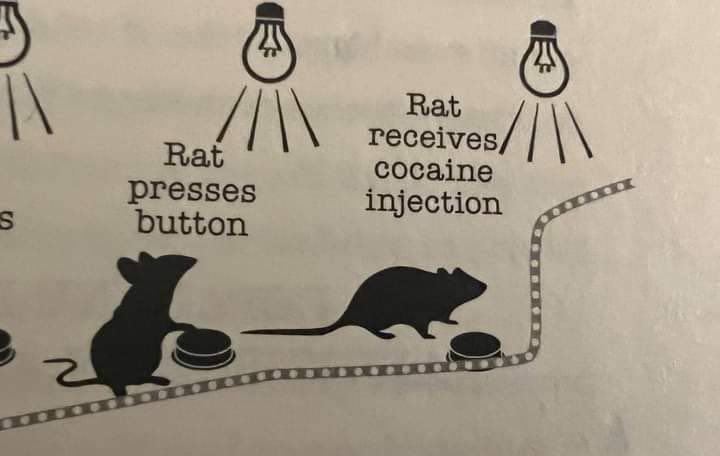
Like, are you a lonely rat pressing the cocaine lever all day? Or are you a solitary monk doing the same simple routine over and over to attain a kind of transcendence?
I think it’s both, there’s a horseshoe theory here.
17 Likes
oh, what I said is just about me. I know that the systems in place are there to take advantage of the most vulnerable and violently rich. I on the other hand line my energy income that I log in once a day, do my 5 minutes of chores for the 1 dollar of free currency and get out
(hey let me talk about how in Genshin they started offering players an extra 60 Unvalued Currency for going through the new story quests they put in each patch. these quests take about 90-150 minutes to blaze through and 60 whatsitsgems is literally 1 dollar in the top-up shop.
I’m making more than that typing out this post at work)
2 Likes
this is just gooning
5 Likes
i’ll read through people’s thoughts on this later, since this is a topic that has come up a lot over the years in various places which other people mentioned.
probably just mentioning things people have already said, but: i just think there are a lot of features of games and game design that have interesting use as tools as a means to an end that are inherently malleable… but people have somehow extrapolated out very pseudosceintifically into these great answers to unlocking the secrets of the universe, or just excellent ways of extracting profit from people (sometimes both) - and these are both somehow great things. it doesn’t really make sense when looked at in the context of larger art history - it all just feels like industry hype propped up by random piecemeal ideals that are easy to buy into if you’re market-pilled and obviously introduce huge ethical questions. and then ofc because video/board game design has been pretty siloed off as a discipline from studies about gambling, we get to pretend video/board game design is not in the same category as casino gambling and there’s some inherent division between the two that probably doesn’t actually exist. a lot of the attempts to deal with the ethical implications of this when it does come up feel kinda half-assed and toothless.
in general i feel this way about “flow”, but also just about the idea of “play” or “gameplay” or whatever in general. just because something has use doesn’t mean it’s like the method for unlocking the secrets of the universe. the way a lot of academics talk about this stuff (at least in the video game space) is just really psuedosciency and gross. very unwilling to seriously take on all the implications of these ideas, very eugenics-lite
7 Likes