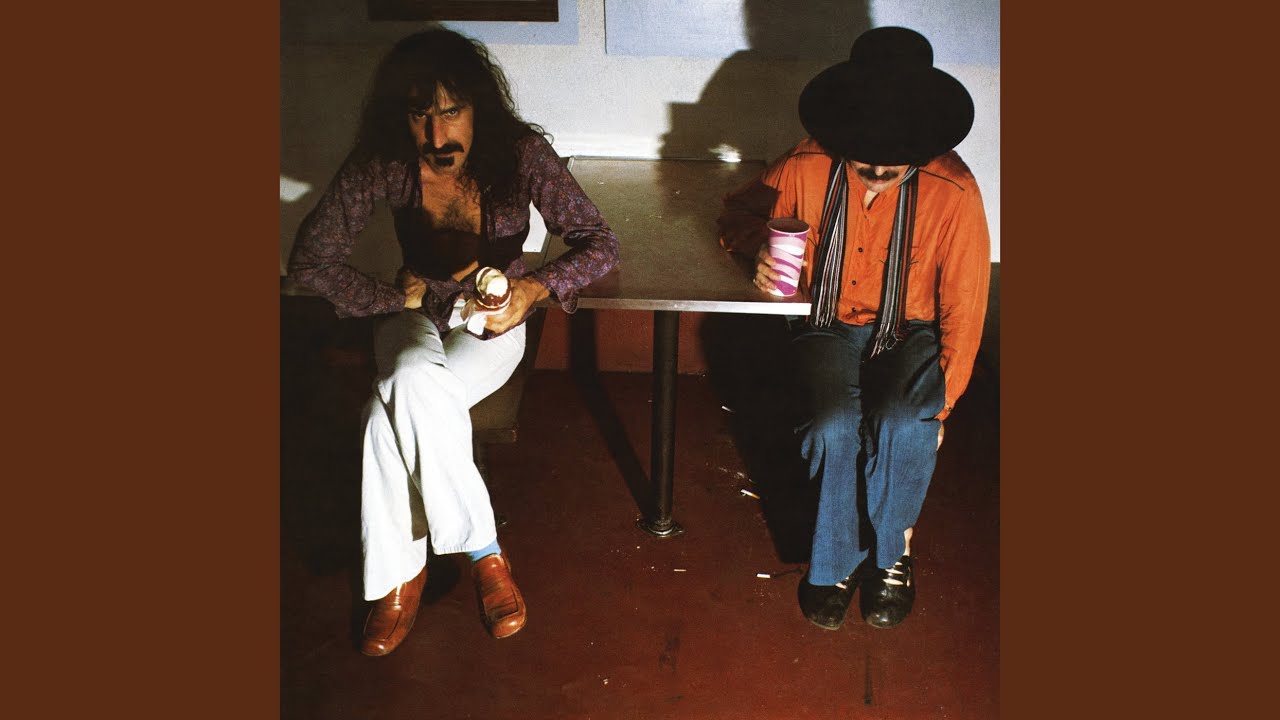
my reading about “lord have mercy on the hippies and f*gg*ts” in 200 motels is informed by familiarity with other zappa work. queer people seem to be part of the big weird tent zappa tried building with all kinds of outsiders and weirdos in the beginning with the mothers. i don’t think he’s generally anti-queer
the things i find most hateful from Zappa are his increasingly odious misogyny and unexamined relationship to masculinity, and his really idiotic anti-union screeds. also some of his anti-racist satirical stuff is just over the line for me too. like i get the “blackface” of joe’s garage and the minstrel-skewering concepts of thingfish, but i think those bits as presented can be harmful or even more pertinently to him, undermining of the entire endeavor. the gleeful insensitivity of it at times is almost nihilistic and unwilling to make the effort to empathize or sympathize. it’s a tough thing. i get the idea of not wanting to compromise and to a degree i respect it, but i just wish e.g. f-slurs, minstrel caricature voices, and blackface weren’t things zappa felt were necessary and needed to be there in the first place
i really shudder at exactly how reactionary he might have become if he lived a much longer life.
the union shit is so stupid, too. like you almost never hear him railing against bosses or corporations in his music (except, again, in the very early stuff). but the unions get these hyper-detailed dressing-downs.
edit: i guess basically after he led a band long enough he started identifying more as a boss and just comprehensively avoided ever empathizing with labor again. it’s like he just met some sleazy LA musician’s union guys in the 60s while he was probably overworking and underpaying his band and didn’t like the union’s policies out of pure self-interest and become a total useful idiot for capitalism forever
I think it’s the paradox of a relatively conservative guy being surrounded by radical counterculture and trying to be a contrarian within all that. He admitted that unions are favourable as an alternative to no worker protections so some of that is really just him venting that session musicians sometimes take the piss.
He also expressed skepticism of ideologies other than capitalism in his book. He takes the uncritical assumption that because ‘people just want things’ capitalism makes sense. He’s a sharp guy but his skepticism of intellectual rigor really led to a lot of brainlice when I think in his heart he held mostly sympathetic values. You don’t write something like Outrage at Valdez and turn around and say capitalism’s the real shit. I think he was expressing contrarian provocation more than being totally straightforward often
just to bring some source material in, this is 1983. it’s effectively reagan propaganda and it doesn’t feel “contrarian” here. just idiotic.
This is a song about the union, friends
How they fucked you over and the way they bends
The rules to suit a special few
And you gets pooched every time they do
You know we gotta stick together x4
Once upon a time the idea was good
If only they’d a done what they said they would
It ain’t no better, they’s makin’ it worse
The labor movement’s got the Mafia curse
You know we gotta stick together x4
Don’t be no fool, don’t be no dope
Common sense is your only hope
When the union tells you it’s time to strike
Tell the motherfucker to take a hike
Yeah Stick Together I think is where he got pulled up on it by an interviewer. It’s not defensible. It provides no meaningful alternative and I don’t think he ever really thought about this issue beyond how it personally inconvenienced his own business.
Yo Cats is a development of the idea and is more specifically the issue he had, though still hugely biased. I think in his mind the Synclavier was the solution but even there he admits it lacks the human element of improv.
i have not yet read his book but i think his music does tend to paint the picture that he’s more or less pro-capitalist (by default if nothing else - he certainly never shies away from satirizing or outright dismissing people with other ideas) and anti-union. and he spends significantly more time skewering unions than the people those institutions exist to oppose
i’d love to hear your take on this, too: thing-fish has a certain “anti-feminist” perspective that i don’t really fully grok, but at a minimum i don’t think it is particularly tasteful or resonant when situated seemingly as a major concern alongside fucking racism and AIDs, if that makes sense.
contrarianism is definitely the right lens to view a lot of Zappa opinions. i do think he’s overall a person with a relatively humane outlook - i think his music wouldn’t still resonate for me otherwise. imo, there’s something about the increasing use of almost “shock” comedy in his work that slowly, gradually steamrolls his empathy as the years go on. i think his early jabs at unions are definitely more defensible than Stick Together for example. they still have some degree of plausible deniability since the more important themes are non-conformity, skepticism of authority, and independence of thought
it’s also worth noting that even in the Mothers days he was a curmudgeon about recreational drug use because he thought it made you dumb and annoying. dude was a grumpy reactionary whose opinions were often formed by how personally irritating he found people. the anti feminist stuff is largely because of second wavers wanting to censor lyrics which is why it’s absent in his earlier work
i find trying to tease a coherent political outlook out of his work kind of a waste of time because of it. you hate to see a guy disappear into his own asshole over petty grievances but this is the favorite pastime of the successful white guy
I think there’s a consistent ‘anti yuppy’ thread that runs through a lot of it but I think it’s partially a disgust reaction to the apparent vapidness of the middle class. Whomst amongst us hasn’t felt similarly but I think Zappa never really gets to class consciousness with it.
I’ll try and explain my thought via Thingfish.
Women are very often depicted as shrill, hysterical voices and very often portrayed as such by male vocalists in his work. The appearance of women that aren’t a formal parody are quite rare exceptions like his collaboration with Tina Turner and the Turnettes or cases where they don’t speak (Ruth Underwood) or are a direct family member. The rest of the time they are usually portrayed as annoying wagging fingers (Rhonda, the woman who says ‘turn it down!’ in Joe’s garage), objects with no merit or brain (Ethel the tree, Jumbo, Mary), or groupies (numerous). Given Frank’s disdain for touring and the rock lifestyle he might be going through that as a lens with regards to his view of women. But I don’t think it ends there.
Thingfish is a really messy text because of the government aspect of the narrative. The characters are mostly horrific caricatures of marginalised people, sort of seen through the perspective of bigoted government but also through Frank’s own lens whether he’s aware of it or not. The Evil Prince in the story is the closest Zappa really gets to discussing the structural reasons for why society might end up in divided bigotry that leads to the stereotypes Thingfish half-lampoons. It’s tragic (or I think so) that the characters basically end up fighting themselves while ‘the man’ gets away with it. However, the messy text means that the horrible stereotypes are front and centre and portrayed from the surface only. There’s no sense of a real humanity or inner life beneath the shell.
To try and tie it back around to ‘anti yuppy’ I think this is where a lot of Frank’s initial gripes come from. A well-founded sense that middle class America is a symptom of real evil (Brown Shoes Don’t Make It). But by the time of Thingfish I think a lot of that has become a surface grievance. Harry and Rhonda are yuppies but rather than go into why they manifest he portrays one as a bullish career woman with a phallus and the other as perverted and closeted.
Zappa once made the observation that women in suits were unnatural because ‘they want to be men’. This is almost a good observation that women who aimed to emulate normative men in the 80s were probably barking up the wrong tree in terms of emancipation from patriarchy but he brings it crashing back down to biological essentialism (women like being in the home and make baby).
He often misses the structural evil beneath the surface caricature and I don’t know if it’s because of a self-assuredness about what he’s viewed on the road or just insecurity. Like Physical says, it may not be a fruitful activity to guess. I think it makes some of the work interesting for how it never fully feels comfortable but gestures at something a more reflective Zappa might have realised. His strongest work that has a political dimension tends towards a dark foreboding vulnerability, particularly of music in a world that doesn’t value it (parts(!) of Joes garage, Phaze 3, We’re Only in it for the Money). He doesn’t deal well with social commentary except when it is literally in the form of documentary.
Reflecting on a line-up comprising Jeff Simmons (bass), George Duke (keyboards, trombone), Ian Underwood (sax, organ), Aynsley Dunbar (drums) and, later, Don Preston (keyboards), Volman says, “in very many interviews, Frank came out and admitted it was the most exciting group he’d ever had, because everyone had been the leader of their own group at one time or another. It was brilliant. Frank could play drums, but with Frank on guitar was Aynsley [Dunbar] on drums and, between them, they made up this improvisational style. It was the same with George [Duke] and Ian [Underwood]. Ian bought a real classic flavor and George brought a real jazzy flavor. Then, when Donny [Preston] joined, we brought a whole other element in, another jazz influence.”